

Suicide
On September 3, 1849, Sarah Shacleford was laundering some clothes with a friend when she suddenly stopped, excused herself, took a long handkerchief from the pile and walked into the woods where she hung herself from an unspecified tree. We will probably never know why she was doing laundry one minute and hanging from a tree the next. At the coroner’s inquest a friend volunteered that Sarah’s mind had been “deranged for some time” and perhaps it was.
The word ‘deranged’ comes up a lot in these inquests. Alexander Rogers cut his own throat with a razor, “being in a state of mental derangement”; George C. Mitchell jumped off his roof “while laboring under derangement”; and Elizabeth Greer shot herself because of a “partial derangement.” Such usage probably says less about the psychology of the victim than that of the witnesses. Suicide simply seemed to them a deranged thing to do.
The word ‘deranged’ covers a lot of territory, however. At her inquest, jurors used the same word to describe Jane Soseby, who hung herself on January 12, 1859. “I thought she presented some signs of derangement,” noted one witness. “I have heard of her being deranged,” noted another, or, at least, “[I] think [I have] seen her when she was not altogether alright.” And indeed Jane was not all right. Because her husband was beating her with anything handy. “I seen one [wound] on her as if she had been struck with a stick,” one witness told the coroner, “and one on her eye as if he had kicked her which she said he had done.” Another witness testified that Jane had showed her “some marks or bruises on her body inflicted as she said by her husband.... I should suppose they were done by a good heavy hickory.” (Southerners grimly knew their timber.)
Such spousal abuse is hardly surprising in an age when men were expected to ‘correct’ their wives as they might children or slaves. The indifference of Jane’s community is a little more surprising. Jane showed her wounds to at least five neighbors, admitted to all of them that she wanted to kill herself, and admitted to some that she thought she might “destroy her children [first] as they were suffering and would suffer” worse when she was gone. But the neighbors could not, or did not, intercede. And so, “no satisfaction to herself or any body else,” Jane tried to cut her throat but found the knife too dull, tried to find a river in which to drown herself, but could never find it, and finally gathered up her courage with her husband’s rope and went to the woods. Jane had found her exit strategy; her children would have to find their own.
Suicide rates have often been used by sociologists and historians as a sort of canary in the cultural coal mine, a way of taking the mental pulse of a nation or group at a particular moment in time. (Emile Durkheim pioneered this line of cultural commentary in Suicide (1897), arguing that integrated populations—Catholics vs. Protestants, women vs. men, people with families vs. those without—commit suicide at lower rates.)
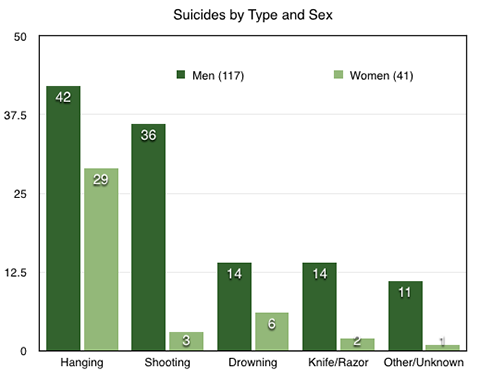
Of the 1190 suicides in the CSI:D sample, 928 were committed by men, 262 by women, a ratio of almost 4:1. Whole books have been written on the “gender paradox of suicidal behavior”—the tendency of women to more often attempt, and men to more often succeed at, committing suicide. (In 2013, 79.1% of deaths by suicide in the United States were committed by males.) But the nineteenth-century rural south was a vastly different world from our own, and all comparisons must be handled with humility. Today, most of the gender paradox relates to method: men are more likely to shoot themselves; women are more likely to overdose, giving bystanders and care-givers a chance to intervene. This was true in the nineteenth century too, where men were most likely to employ a firearm, women a poison.
In the inquests collected here, 31% of antebellum men and 7% of antebellum women killed themselves with a gun. Such lopsidedness is notable although it is less than what we see in the United States today where 85% of successful suicides are committed by firearm. In the antebellum CSI:D sample both sexes were most likely to hang themselves, rope being by far the most affordable and familiar ‘technology’ available. This conforms to the latest research suggesting that it is not true that determined depressives will always find a way to kill themselves. Rather availability shapes the outcomes. The classic example is Britain in the 1950s, where for the first half of the decade stoves were fueled by a coal-derived gas with a high carbon monoxide content, making gas inhalation the most common method of suicide. In 1958, when the country began switching over to natural gas, not only did gas-inhalation suicides go down but so did suicides generally. To a degree, a prevalence of means creates a prevalence of ends.
But only to a degree. The ‘why’ matters as much as the ‘how.’ Suicide correlates strongly with unemployment, trauma (including military service), and depression, along with their typical chasers—alcoholism and substance abuse. These forces are clearly at work in these inquests as well, though the victims were not, by and large, living lives of quiet desperation and succumbing to losing battles with what Churchill called the ‘black dog.’ Instead they were living lives of actual desperation in which suicide probably was the only way out.
This is most obvious in the case of the enslaved, and quite a few of these inquests were done over the bodies of men and women who saw suicide as an act of self-emancipation. In June 1847, for instance, an enslaved woman named Nancy was busy shucking corn when her mistress asked her to go to the stable to feed the horse. When Nancy’s baby started crying, the mistress went in search of Nancy and found that she had continued on through the stable and drowned herself in the Saluda River. Nancy had “complained for the last few days, and in one case yesterday acted as if deranged,” the mistress told the coroner, but it is equally likely that Nancy had simply reached her breaking point with enslavement mid-shuck. More typical triggering events, however, were imminent punishment or recapture. The dogs closing around her, an enslaved woman named Lovina plunged into a mill pond knowing full well she didn’t know how to swim. It is hard to quite call this a suicide. Was Lovina choosing to die or choosing to no longer be enslaved?
This sense of being cornered, literally or figuratively, is a common refrain among the white suicides as well. Doctor John J. Cobb drowned himself in Elkins Mill Pond rather than follow through on a marriage. (The would-be bride’s family was threatening to kill him if he didn’t, so it seems possible that he had impregnated her out of wedlock.) Money pressures too could drive men to the breaking point. E. M. Whatley shot himself in the head, telling his family that “he was not able to work for them and that before he would be a drag to his family he would put an end to him self.” Adam Barker shot himself twice in the chest, saying he would “rather be dead than to be poor and beholding.” There were, however, clearly cases in which internal mental issues, rather than external pressures, played a leading role. Jacob Pruitt, for instance, shot himself in the abdomen because he wanted “out of this troublesome world” and when Solomon Ellenberg gathered up some rope and left his house for the last time, he told his daughter he just “could not stay here any longer.” “I knew he] was gone to kill him self,” she told the coroner, and “[I] never expected to see him alive again.”
NEXT: Accident
Suicide Inquests
| Name | Deceased Description | Date | Inquest Location | Death Method | Inquest Finding |
Child |
|---|---|---|---|---|---|---|
| George Smith | December 27, 1914 | at Mr. Geo. Smith's Residence, Chesterfield County, SC |
upon their oaths, do say: That he came to his death by gun shot wounds. Inflicted by his own hands |
|||
| John Autery | March 26, 1858 | in the district aforesaid, Greenville County, SC | rifle |
upon their oaths do say that the deceased came to his death by shooting himself with a rifle gun, the ball sticking in the forehead and penetrating into the skull which caused instant death, his big toe placed on the trigger, the gun lying lengthwise on the body |
||
| Henry Reece | November 9, 1827 | at Peter G.?, Laurens County, SC |
upon our oaths aforesaid do say. That the said Henry Reece did. . . hang and Kill himself in the Manner aforesaid |
|||
| Lucy Gray | December 27, 1867 | in the house of John Brown, Spartanburg County, SC |
upon their oaths do say that the said Lucy Gray came to her death [by] voluntarily & feloniously hanging herself by the neck in the house of John Brown aftoresaid to one of the joist of said house |
|||
| William Mahan | single man | November 20, 1810 | Union County, SC | hemp rope |
upon the oaths . . .do say that the Sd Wm Mahan for want of the Grace of God & the instagation of the Divel Came to his Death by forcing a small hemp rope Round his neck to a Beam of the house in his own BeadRoom where with he hangd himd Self Dead |
|
| C. B. Collins | November 4, 1900 | at C.B. Collins', Chesterfield County, SC |
upon their oaths, do say: we the Jurors find that the deceased C B Collins came to his death by a gun shot wound inflicted by his own hand |
|||
| Doctor James Glenn | June 8, 1831 | on the high way, Fairfield County, SC | laudanum |
do say upon their oaths that he came to his death by the affects of Laudnum. Given under own hand |
||
| Robert Blair | March 25, 1828 | at the mill of James Cunningham ... on a branch of Shingeton's[?] Creek, Kershaw County, SC |
do say upon their oaths. . . that the s'd Robert Blair came to his death by drownding himelf in the Mill pond of James Cunningham's |
|||
| Joel W. Miller | February 2, 1874 | at Gen'l J.W. Miller's, Spartanburg County, SC | pistol |
upon their oaths they do say from the evidence and circumstances connected that said Gen'l J.W. Miller came to his death from a pistol ball discharged from a pistol held in his one hand |
||
| Cuffy | April 19, 1853 | at Dorroughs Mill, Laurens County, SC |
upon their oaths do say we believe that said Slave did voluntarily feloniously himself kill by drowning against the peace and dignity of Said State afforesaid |
|||
| Ann | negro woman | December 8, 1848 | at the house of Benja F Landrum, Edgefield County, SC | rope |
upon their oaths do say the said Decd came to her death in the Shop of B F Landrum by hanging herself with a rope around her neck |
|
| John Hayne | May 16, 1861 | At the house of Capt. John Hayne, Anderson County, SC | rifle |
do say that he came to his death by an leaden bullet from a rifle gun of the value of five dollars which from all appearances was fired by himself |
||
| Warren Richards | August 18, 1894 | Laurens County, SC | train | |||
| Nancy Poole | March 31, 1841 | at Nancy Pool's, Spartanburg County, SC | rope |
uppon [sic] their oaths do say by violence at her own house. . .by hanging herself with a rope by the neck |
||
| Daniel Coleman | November 21, 1837 | at the house of Mrs Citha Rowles, Union County, SC |
do say upon there oaths . . . not having god before his eyes and at the instigation of the Devil Commited Suiside by drounding himself in Broad River |
|||
| J. Hancock | June 13, 1859 | at J. Hancocks, Edgefield County, SC | shotgun |
upon there oaths do say that the said J. Hancock came to his death by a shot from a doubble barrell shot gun left hand barrell of said gun shot entering the boddy about the navel and little on the right side killed in his own house. . .himself did kill |
||
| Massie Robeson | June 18, 1919 | Chesterfield County, South Carolina, Chesterfield County, SC |
we the Jurors find that she came to her death by her own hand by gun shot wound |
|||
| Allen | negro man | September 4, 1858 | at Mrs. Moor's, Greenville County, SC | rifle |
upon their oaths do say that the deceased came to his death by ball shot from a rifle gun into his forehead causing instant death, the gun lying by his side, the ram rod drawn out and lying on the ground, a long forked stick lying lengthwise on the body |
|
| John Meador | January 18, 1828 | at the house of Mrs Nancy Parks, Laurens County, SC |
do say upon their oaths that the said John Meador not having God before his eyes but being moved and seduced by the instigation of the devil at the North West end of Mrs Nancy Parks about two hundred yards from the dwelling house of the Nancy Parks, did voluntarily and feloniously and of his malice aforethought shoot himself with a rifle Gun, carrying aboutone hundred and fifty balls to the pound, the Gun worth fifteen dollars and that the said John Meadow placed himself on his back on the ground, and laid the said Rifle Gun with the muzzle near to and under his chin, and with a hickory stick about three feet long pushed back the trigger and shot him self under the chin giving himself a mortal wound... |
|||
| Pleasant T. Gossett | November 18, 1870 | Spartanburg County, SC |
upon their oaths do say that the said P.T. Gossett came to his death by hanging himself by the neck between the cribs at home |
|||
| William Malone | June 6, 1844 | at the residence of Wm. Malone, Union County, SC | pocket knife |
upon their oaths do say that the said Wm Malone came to his death by cutting his own throat with a pocket knife in a state of mortal derangement near his own house |
||
| Peter | July 7, 1833 | at the plantation of Captain Chernal[?] Durham, Fairfield County, SC |
do say on their oaths do certify that the above named negro Peter came to his death by a voluntarly act of his own by hanging himself with a hickory with to a limb of an oak |
|||
| Adam | slave | August 22, 1828 | at Camden, Kershaw County, SC |
do say upon their oaths that the said negro man Adam the property of Solomon Legare died by his own act, having hung himself |
||
| Eliza Jane Huckaby | April 24, 1874 | at the house of Jane Littlefield in Cross Anchor township, Spartanburg County, SC | rope |
upon their oaths do say that. . .the said Eliza Jane Juckaby came to her death by her own hands by hanging herself with a rope in a rather mysterious way |
||
| Samuel Hudgens | November 9, 1854 | at Samuel Hudgens, Laurens County, SC | laudanum |
upon their Oaths do say it appearing from the examination of the body, & Testimony that the said Samuel Hudgins came to his death at his own residence on the 9th of November 1854 from an accessive [sic] uses [sic] of Laddnum taken at his own will & from his own hands. |
||
| William L. Russell | September 6, 1849 | in the Hotel of H Jordon, Edgefield County, SC | razor |
upon their oaths do say the said William L Russell came to his death . . .by cutting his own throat with a Razor while in a temporary state of insanity |
||
| Hutson B. Sulivan | August 13, 1866 | at Kely Sulivan's [?] residence, Anderson County, SC | rope or cord |
upon oaths say that the deceased came to his death by self murder by hanging himself with a rope, or cord supsended to a rafter of the house where he was found |
||
| M. F. Anderson | February 22, 1883 | at the residence of JR Anderson, Laurens County, SC | strychnine |
upon their oaths do say that the said M F Anderson came to her death by taking an overdose of Strychnine and that the said M F Anderson in manner and form then and there voluntarily and feloniously herself did kill against the peace and dignity of the same State aforesaid. |
||
| Dick | slave | May 25, 1845 | at the plantation of Margaret Montgomery's near Sedar [sic] Shoal Creek, Spartanburg County, SC | small rope |
do say upon their oaths that the above named Dick not having the fear of God before his eyes but being moved and seduced by the instigation fo the Devil did voluntarily hang himself with a small rope on a limb of a walnut tree |
|
| James Comer | November 28, 1817 | Union County, SC | rifle |
do say upon their oaths that the Said James Comer for Wont[?] of the Grace of God and the instation[?] of the Devil was a [?] of himSelf By Shooting of him Self with a Rifle gun in the forehead |
||
| Darling Willis | March 4, 1859 | at Wade Holeston warter, Edgefield County, SC | pistol |
upon there oaths do say that the said Darling Willis came to his death by the shot of a pistol in his own hands in his house |
||
| J. T. Hanna Sr. | February 2, 1934 | at Teal's Mill, Chesterfield County, SC |
upon their oaths, do say: We the Jury find that J.T. Hanna Sr. came to his death by a gunshot wound in his own hand |
|||
| Howard Birdsong | August 4, 1863 | at Greenville, Greenville County, SC |
upon their oaths do say that he came to his death by his own hands by "Hanging" |
|||
| Mary Peck | February 23, 1828 | in the District aforesaid, Laurens County, SC |
do say upon their Paths, "That the said Mark Peck, came to her death, hanging herself with a hank of spun cotton, to the end one of the logs of the Chimney, while in a state mental derangement. |
|||
| Silas McKinney | July 8, 1871 | at the Parrish, Spartanburg County, SC |
upon their oaths do say that the sd. Silas McKinney did voluntarily hang himself by the neck and took his own life against the peace and dignity fo the same state aforesaid |
|||
| William McMahan | November 20, 1810 | in his own home, Union County, SC | hemp rope |
do say on their oaths that for want of the Grace of God and the instatigation of the Divel did William McMahan hang himSelf with a hemp Rope fixt[?] [?] his own BedSide |
||
| Peter | October 25, 1834 | at Robertson Osborns, Laurens County, SC |
upon there oaths do say that the said (Slave) Peter came to his death By cutting his throat with his own hand - with his Shoe Knife valued at 10 cts. |
|||
| Josiah Parker | August 24, 1829 | at the plantation of Josiah Parker, Kershaw County, SC |
do say upon their oaths . . . that on the night of the 23rd of August 1829 . . .the said Josiah Parker. . . did wllfully throw himself in a well and then and there did drown himself against the peace of this state. |
|||
| J. H. McPherson | January 3, 1877 | at Gaffney City, Spartanburg County, SC | pistol |
upon their oaths do say that he, the deceased, came to his death from the effects of a pistol shot wound in the head, inflicted by his own hand |
||
| James Hitt | April 1, 1857 | at Mary Hays, Laurens County, SC |
upon their oaths do Say, they find a severe cut on the inside of the right Thigh and a cut on the head appears to have been inflicted by a knife but where done, or by whom done is to them unknown but upon their oaths do say that the Deceased came to his death from wounds inflicted upon his person as above stated by some person & means unknown to them... |
|||
| Ellick | negro man | April 26, 1851 | at the house of W. F Prescott, Edgefield County, SC | rope |
upon their oaths do say, that the said Ellick, . . .voluntarily, and feloniously, himself did Kill. By hanging himself by the neck, suspended by a rope form the joist |
|
| Daniel | slave, boy | April 28, 1859 | at L. Halls Tisery[?], Edgefield County, SC |
upon there oaths do say that. . .Daniel came to his death by drownding whether axidental or intentional unknown |
child | |
| Sam | September 15, 1861 | at Joseph Hurts'[?], Fairfield County, SC |
upon our oaths do sa, that the slave boy Sam, in manner and form aforesaid, then and there, voluntarily and felonously himself did kill, by hanging himself with arope around the kneck on Sunday Evening the 15 |
child |