

Homicide
In 1827, a slave named Ambrose escaped from his owner Berryman Burger. Like most runaways, Ambrose did not make the dangerous trek north but remained in the area, a practice called ‘lying out.’ In most cases, such slaves kept a low profile, living off the land or from scraps gleaned from friends and compatriots in the quarter. Ambrose, however, took a different path, waging guerrilla war against slavery and local slaveholders. Over the course of more than a year he broke into barns, slaughtered hogs and poultry, pillaged smokehouses, burned outbuildings, destroyed cotton, and generally behaved like a local Robin Hood, stealing from the rich and returning to his fellow slaves. Within months, Ambrose had induced other runaways to join him, and he was regarded by local planters as a “desperate character ... capable of any act of villainy” who should be killed on sight.
Early in the morning of September 24, 1828, a local white man, Kirkland Harmon, surprised Ambrose in his camp and gunned him down as he rose. Ambrose winced as the buckshot “enter[ed] his back loins & hips,” and he bled out on the ground. His one-man rebellion was effectively over. Without the coroner’s inquest convened over his body, however, we would know nothing of his rebellion; the record of his death is the only record we have of his life. How many Ambroses were there? It is hard to know. To its credit, Ambrose’s band picked up his mantle and continued to operate in the area as a plague to local planters.
I was not surprised to learn that such local resistance was quashed and that slaves like Ambrose were routinely murdered. I was surprised to learn how often the coroner responded. In her WPA interview, the former slave Mittie Freeman remembered the coroner as “that fellow that comes running fast when somebody gets killed,” and the coroner is mentioned in quite a few of the most famous slave narratives, including those by Frederick Douglass and William Wells Brown. The coroner was often the only magistrate mentioned because he was the only ‘outside’ law the slaves ever saw. We will never know precisely how many enslavers murdered their slaves and effortlessly covered it up. But in cases where the murderer was someone other than the enslaver, or where the enslaver failed to cover it up, there usually was an investigation, at the very least because property had been destroyed, and someone expected compensation.
Reflecting on the South he was forced to flee because of his Unionism, John Aughey noted: “Of course the laws which exist in every state against the murder or torturing of slaves are about as well observed as might be laws enacted by wolves against sheep-murder.” But in the coroners’ inquest there was actually a subtle game of community standards going on. Standing over the body of a slave and surveying the grim damage, a coroner’s jury was often perfectly comfortable recommending that a white be indicted. And at coroner’s inquests slaves were allowed to testify. The actual jury nullification came later, in the courtroom, when the mangled body was not actually present and the murderer was let off. But by then he had been held up to public scrutiny; his judgment and decency had been questioned publicly and legally. It is less than justice, but it is not nothing, a fact which slaves themselves recognized. When the coroner came a-runnin’, many slaves thought he might bring justice with him from some far off, saner place. And in his own Narrative, Frederick Douglass tells the story of an unnamed slave girl whose mistress “pounded in her skull” with a piece of firewood because she allowed a baby to cry uncontrollably and wake the household. “I will not say that this murder most foul produced no sensation. It did produce a sensation. A warrant was issued for the arrest of Mrs. Hicks, but incredible to tell, for some reason or other, that warrant was never served, and she not only escaped condign punishment, but the pain and mortification as well of being arraigned before a court of justice.” It is hard to believe that for all he’d seen of the institution of slavery, Douglass still thought it capable of any justice at all.
What does not make it into many of the slave narratives, including Douglass’s, is the violence that existed within the slave community. Enslavement does not magically transform all who endure it into savvy, self-sustaining freedom-fighters. If we are going to grant the enslaved their full humanity we must grant that, like any other group of people, they occasionally fought, fornicated, and got into petty disputes that sometimes took a murderous turn. To be sure, as historian Steven Hahn has noted, the slave quarter produced one of the most radical and transformative politics ever seen in America, a politics that produced Nat Turner and Frederick Douglass and finally brought down a $3.5 billion dollar interest. But in coroners reports we get a glimpse of the violence that existed within the slave community that we knew had to be there. Thus did the enslaved of the Haile plantation turn their children over to Tamer, the enslaved nurse, on their way out to the fields, little knowing that she liked to punish the children by tying them too close to a fire, a practice that was only discovered when she finally cooked one of them to death. Or take the case of an enslaved man named Dick who became so jealous that he pulled a log from a fire and murdered the man who was staying in the cabin of a woman he wanted to sleep with.
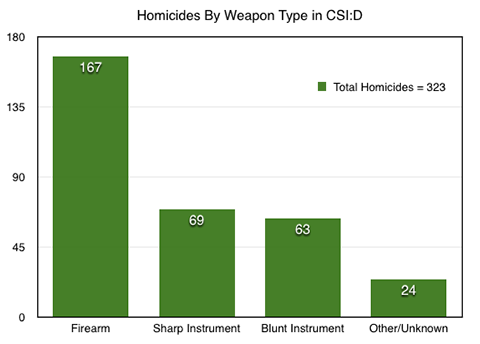
Today, the typical homicide in the United States involves one man shooting another, and this is equally true in the CSI:Dixie database. Comparatively speaking, the CSI:D sample has a higher percentage of male victims and a lower percentage of gun use. Today firearms are used in 68% of American homicides; in the CSI:D sample guns are used 52% of the time. Today 77% of homicide victims are male; in the CSI:D sample 88% are male (and virtually all of the perpetrators are men). Put bluntly, in the nineteenth century south, violent death was a more exclusively male province, and Death had more faces.
Interestingly, though, in the CSI:D database virtually none of the gun-related homicides are related to robbery. Most are the product of the highly combustible combination of anger and alcohol. The last words of J. Edward Sims were typical: “Shoot you damed cowardly son of a Bitch.” Or take this poignant exchange:
Tom Rutland (firing): “I will kill you, you son of a bitch.”
William Padgett (bleeding): “You have already.”
In the strange alchemy of the male brain, friends became mortal enemies in an instant, often over trivialities. “How in the hell did you Gap up My ax?” Gus Settler demanded to know of Allen Holmes in March 1882. I hardly know what a gapped-up axe looks like, but I do know that returning a borrowed tool in less than satisfactory condition is no grounds for murder. Settler disagreed and shot Holmes dead.
Infanticide
Life in the Faulknerian world of CSI:D was especially cheap for children. Catherine Berry, a domestic in the R. C. Poole household, was told that she would be terminated if she was indeed pregnant. In an awful feat of endurance, she continued with her chores until, doubled over with pain, she snuck away to give birth in the potato shed. Reeling from the loss of blood, she still managed to strangle the baby and fling it into the Pacolet River, where it washed up at the feet of some fishermen. When Peggy Bedenbaugh felt her first contractions, she went out to a corner of the yard, gave birth in a hole, and covered the baby over with dirt. Luly Collins threw her baby down a well. Nancy Owens swept hers under a brush pile. All had denied for months that they were in the “family way”; all had killed the evidence; all were indicted for murder.
Or take the case of Jane Arnold. On September 7, 1857, Brazeal Cox and his wife found sixteen-year-old Jane Arnold stretched out on the ground with a baby beside her, bleeding from its umbilical cord. When Arnold became aware of the couple she called out to Mrs. Cox, who wrapped the dying infant in Arnold’s apron and took it into the Arnold home. Mrs. Cox then returned and asked the girl why she hadn’t given birth indoors. Because her daddy was “doging” her, she said, and had cast her from the house. “She seemed to be grieving,” Cox told the coroner in a model of understatement, “but [I] don’t know what for, whether on the part of her dead child or the abuse of her father.”
Three years later, at four in the morning, a shivering Jane Arnold knocked at the door of a neighboring farm. She was cold and unkempt, but she couldn’t make up her mind to stay. Instead she returned to the abandoned schoolhouse where she had taken her latest baby, born in the middle of the road, to die of exposure.
The coroners’ office reveals a world where men force women into sex and women pay the price for it, in embarrassing pregnancies, social stigma, and the occasionally desperate attempt to cover up the evidence. In 1829 a fire in Thomas Welsh’s smoke-house revealed a small cubby in which a full term child had been secreted in a jar of lime. It is impossible to know whether this was an infanticide or a child who had been stillborn. Regardless the mother was covering up something. Occasionally that something was an interracial liaison. More often it was simply a pregnancy out-of-wedlock. Many of the cases reveal that the women had been trying for some time to induce an abortion. ‘Home remedies’ for pregnancy mentioned in the CSI:D sample include savin powder mixed with turpentine, red bark bay tea, and the ashes of dried corn cobs. In this sense some of the infanticides might be considered extremely late-term abortions. One unnamed mother, for instance, gave birth to a stillborn child who bore unmistakable marks of abuse en utero. M. Lipscomb was found doubled over a fence having apparently bled out in a botched, self-induced abortion.
Almost sadder is the number of women who were held to account for the ‘murder’ of infants who had most likely died of crib death or SIDS. Often sent back to the cotton field within days of giving birth, enslaved mothers were understandably exhausted, and they often slept with their infants so they could breast feed in a haze and go back to sleep. When they occasionally awoke to dead babies, they were unfortunately as susceptible as their doctors and enslavers to believe that they had smothered their children in their sleep, a phenomenon which only enhanced their reputation as uncaring and unnatural mothers.
NEXT: Suicide
Murder Cases Tried in South Carolina, 1887-1900
| Year | Number of Homicides Tried | Not Guilty Verdicts | Guilty Verdicts | Cases Dismissed or Continued | Percentage Found Guilty |
|---|---|---|---|---|---|
| 1887 | 79 | 54 | 11 | 14 | 13.9% |
| 1888 | 117 | 61 | 36 | 20 | 30.1% |
| 1889 | 120 | 69 | 30 | 21 | 25.0% |
| 1890 | incomplete returns | - | - | - | - |
| 1891 | 151 | 76 | 46 | 29 | 30.0% |
| 1892 | incomplete returns | - | - | - | - |
| 1893 | incomplete returns | - | - | - | - |
| 1894 | incomplete returns | - | - | - | - |
| 1895 | 210 | 112 | 67 | 31 | 31.9% |
| 1896 | 201 | 110 | 67 | 24 | 33.3% |
| 1897 | 215 | 120 | 64 | 31 | 29.7% |
| 1898 | 248 | 105 | 96 | 47 | 44.0% |
| 1899 | 205 | 83 | 97 | 35 | 47.3% |
| 1900 | 224 | 127 | 71 | 26 | 31.7% |
Credit: John Hammond Moore, Carnival of Blood: Dueling, Lynching, and Murder in South Carolina, 1880-1920 (Columbia: University of South Carolina Press, 2006), pp. 130-131, taken from Reports and Resolutions of the General Assembly of the State of South Carolina
Homicide Inquests
| Name | Deceased Description | Date | Inquest Location | Death Method | Inquest Finding |
Child |
|---|---|---|---|---|---|---|
| Luke Smith | October 14, 1931 | at Cheraw, Chesterfield County, SC |
upon their oaths, do say: We the coroners Jury in the case of L. Smith find that L. Smith came to his death by Gunshot wounds of Gun in the hands of Paul Cuffin |
|||
| Rose | negro woman Slave | March 14, 1846 | at Michael Longs, Edgefield County, SC |
Upon their Oaths do say that the aforesaid Rose being chained in the Meat house of said M. Long, around the neck with a common chain trace with one ened and the Other end of said chain aforesaid to the Joist broke her neck either by design or by accident |
||
| Unknown Colored Man | Unknown Colored Man | July 5, 1892 | at Will Davis, Laurens County, SC |
upon their oaths do say that the unknown man came to his death from Gun Shot wound in the hands of A B Blakely in self defence. |
||
| Robert J. Butler | September 15, 1864 | at Hamburg, Edgefield County, SC |
upon there oaths do say that Robert J Butler sen[?] came to his death by gun shot wound inflicted by Doct J D Twiggs |
|||
| James M. Rhodes | August 27, 1862 | at the residence of James M. Rhodes, Spartanburg County, SC |
upon their oaths do say that. . .J. William M. Brown ... then and there [did] inflict three severe blows upon the head of deceased fracturing his skull in two places |
|||
| Haman Miller | October 30, 1824 | at Blacks Store, Laurens County, SC |
upon their oaths do say that the said Haman Miller came to his Death by Violence committed on his sides by a number of Blows with the fist of John Prince and a fall... as a consequence of of Said Blows, and that the said John Prince did then and there feloniously Kill and Murder, against the peace and Dignity of this State. |
|||
| Walter Brown | November 26, 1943 | at Cheraw, Chesterfield County, SC |
upon their oaths do say that Walter Brown received in Chesterfield County a mortal wound by _______ in the hands of Mose McKay. . . He came to his death by a gun in hands of Mose McKay. |
|||
| James Anders | November 28, 1881 | at M. B. Ander's, Greenville County, SC | pistol |
he came to his death by the Shooting of some kind of fire arms two holes in his Head and one in the lore part of his Bowels . . .he was shot by a pistol from the hand of one Bengeman |
||
| Andrew | freedman | March 13, 1866 | at Greenville CH, Greenville County, SC | pistol |
upon their oaths do say that by a pistol shot on th Pendleton Road . . . fired from a pistol in the hands of a United States Soldier |
|
| Vincent Hanes | Fairfield County, SC | stick | ||||
| negro woman | negro woman | March 26, 1840 | at John Garrotts, Union County, SC |
upon their oaths do say that . . .they believe she the said negro woman come to her death by drinking too great a quantity of water which they believe caused inward pain and perhaps spasm |
||
| Hammond Frasier | November 6, 1897 | at Trenton S.C., Edgefield County, SC | pistol |
upon their oaths do Say: That Hammond Frasier come to his death by a gun Shot wound and the Said wound was made by a pistol in the hand of James Hampton |
||
| Cesar | Negro, negro boy | July 7, 1843 | at the house of Elijah Watson, Edgefield County, SC |
upon their Oaths do say. . .believe said negro came to his death by a sever blow given him by Jerry one of said Watsons negroes not with the intention to Kill |
||
| J. M. Clark | July 19, 1897 | at J.M. Clark's residence, Laurens County, SC |
upon their oaths do say that J.M. Clark came to his death by Gun shot wounds inflicted by the hands of Willie Franks on the 10th day of June 1897 and that his father F.B. Franks was accessory to the act. |
|||
| Charles Little | June 11, 1934 | at Chesterfield, Chesterfield County, SC |
upon their oaths, do say: as the result of pistol shot in the hands of W. Lester Russell |
|||
| Amaziah Payton | colored man of New York | July 20, 1866 | at the house of Richmond Payton, Anderson County, SC | pistol |
do say that the aforesaid Amaziah Payton came to his death. . . from the effects of a wound a little above the left groin, suppose to have been made by a pistol ball?.which ball was shot from a pistol which one Reuben L. Golding then and there had and held |
|
| Charles M. Creswell | August 5, 1869 | at Edgefield CH, Edgefield County, SC |
the said Charles M Creswell came to his death do say that . . .the deceased Charles M Creswell came to his death by a gunshot wound from a gun in the hands of some person or persons unknown |
|||
| Reece Chapman | July 26, 1948 | at Chesterfield, South Carolina, Chesterfield County, SC |
VERDICT: The said Reece Chapman came to his death by a 31 Pistol at the hands of Buck Diggs. |
|||
| Anthony | October 30, 1860 | at Dr. McCoys, Laurens County, SC |
upon their oaths do say that Antony came to his death from Shot wounds of a gun in the hands of John P Templeton on the 29th day of Oct |
|||
| Edward Bridges | March 19, 1881 | Spartanburg County, SC | ||||
| Lewis Moore | November 30, 1891 | at the plantation of Robert Smith, Edgefield County, SC | pocket knife |
upon their oaths do say that one Lewis Moore . . .came to his death from wounds in right arm inflicted with pocket knife in the hands of Robert Bauknight (Col) |
||
| Christopher Campbell | April 16, 1835 | Kershaw County, SC |
after hearing the evidence together with the opinion of Doctors DeLeon and Young are of opinion that the deceased came to his death from a disease of the brain hastened by blows on his head inflicted by some person or persons unknown |
|||
| Abe Dubose Jr. | at the old[?] mill place of S.D. Dunn, Fairfield County, SC |
upon their oaths do say that the said Abe Dubose Jr. came to his death by a gunshot wound at the hands of William Dubose and that Frances Dubose is accessory to the killing[.] |
||||
| Marten Lowery | January 20, 1913 | at Liza Lowery's, Chesterfield County, SC | pistol |
upon their oaths, do say: That the said Mart Lowery came to his death from a pistol shot wound in the hand of Henry McKinzy |
||
| Apling | negro man | April 5, 1849 | in the woods in said district near the Lexington line on a branch of McGier Creek, Edgefield County, SC |
do say upon their oaths do say that they believe the decd to be the remains of Ap or Apling . . .and that he came to death by a leaden ball shot from a gun[?] or pistol by the hands of some person or persons unknown |
||
| John Webb | March 26, 1899 | at Edgefield Court House, Edgefield County, SC |
upon their oaths do Say that the aforesaid John Webb came to his death by Gun Shot wounds inflicted by weapons in the hands of Robert Coile[?], Dan Coward Hill Howard, and R L Burnett as principals, Milledge Reece and A.J. Corley as accessories |
|||
| Levi H. McDaniel | March 9, 1859 | at or near the 17 mile Post on the Scotts Ferry Road, Edgefield County, SC |
upon there oaths do say that. . .the deceased came to his death by a Pistol shot in the left side near the region of the heart fired from the hands of one James H. Jones |
|||
| Edom | slave | November 7, 1832 | Spartanburg County, SC | whip |
do say upon their oaths that. . .the said Edom did come to his death by the [?] Gabriel Cannon[?] striking him on the head with the but [sic] of a whip |
|
| Ephram Neetles | February 1, 1890 | at the residence of Ephram Neetles, Laurens County, SC |
upon their oaths do say. That the said Ephram Neettles came to his death by a shot from a Pistol in the hands of Rich Davenport - and George Henderson and Hugh Henderson being acceessories. |
|||
| Albert Jenkins | September 13, 1937 | at Cheraw, Chesterfield County, SC |
upon their oaths do say that Albert Jenkins received in Chesterfield County a mortal wound by Pistol Bullet in the hands of Buster Ellebre |
|||
| Giles Guess | colored | February 2, 1882 | at the hosue of John Smith, Anderson County, SC | pistol |
do say that the deceased was willfully killed by the hand of one Isaac Putnam by shooting deceased with a pistol and that Silas Putnam was accessory to the killing about seven or eight oclock in the afternoon at the house of one John Smith |
|
| Thomas Booth | August 23, 1878 | at E. C. House, Edgefield County, SC | pistol |
upon their oaths do Say that the said Thos Booths. . .came to his death by pistol Shots from the hands of parties unknown |
||
| Peter | October 25, 1854 | Laurens County, SC | ||||
| Sam Dehays | October 23, 1870 | at Thernus quarter, Laurens County, SC |
upon the oaths do say that the said Sam Dehay came to his death on the road between Duncans creek & Clinton on the 22d Oct 1870 by a gunshot from parties unknown to the jury |
|||
| Isaac Salter | June 7, 1872 | at the old Colemans Quarter, Laurens County, SC | pistol |
upon their oaths do say that Isaac Salter came to his death, upon their oaths do sayeth by a pistol shot in the hands of Amos Anderson |
||
| Mastin Comer | January 6, 1862 | at Mastin Comer's, Union County, SC | knife |
upon their oaths do say . . .that the deceased came to his death by a wound inflicted in the forepart of the head by seaborn[?] woolbright with a knife |
||
| Susan Medlock | April 7, 1894 | at Johnston, Edgefield County, SC |
upon their oaths do say that the said Susan Medlock aforesaid, Came to her death by injuries inflicted upon her by the hands of Boston Jones Jr |
|||
| W. F. Hunter | June 1, 1853 | at the residence of William Clyburn, Kershaw County, SC | knife |
upon their oaths do say that the said William Ferdinand Hunter came to his death by wounds inflicted by a knife in the hands of John Love, Junior, in the woods near the residence of William Clyburn, about twelve miles north of Camden, on the road leading to Lancaster, on the thirty-first day of May A.D. 1853 |
||
| Charlotte | February 22, 1862 | at Conwayboro, Horry County, SC |
Upon their oaths do say that Charlotte a slavey here lying dead before us came to her death by a wound inflicted by a six Barreled repeater in the hands of James J. Wortham on the 20th of February 1862 |
|||
| Tobe Woods | May 19, 1931 | at Cheraw, Chesterfield County, SC | pistol |
upon their oaths, do say: that Tobe Woods came to his Death By Gun Shot Wound in the hand of James Johnson |
||
| William | negro man, boy, slave | February 13, 1849 | at R. F. Barretts, Edgefield County, SC | knife |
Do say upon their Oaths that one Samuel Butler of the District aforesaid not having God before his eyes, but being moved and seduced by the instigation of the Devil . . .with force & arms at his place of residence . . .made an assault, and . . .with a certain Kinf & whip ... did inflict ... several wounds and bruses of which wounds & bruises he lingered and died |
|
| Archibald Nicholson | July 26, 1869 | at the residence of Archibald Nicholson, Chesterfield County, SC | pistol |
upon their oaths do say, that the said deceased came to his death by a blow or lick inflicted on the side of the head, at Mount Croghan in the County aforesaid on the 24h day of July, A.D. 1869 with a Gun in the hands of Jacob Brewer |
||
| nameless newborn boy or male child | nameless newborn boy or male child | January 12, 1885 | at T P Byrds Campbell place, Laurens County, SC |
upon their oaths do say that the said nameless boy or male child came to his death on the 10th day of January AD 1885 and in Laurens County by strangulation cause by criminal negligence on the part of Kittie F. Malone. |
||
| Prince | slave | January 15, 1865 | at John Seiglers, Edgefield County, SC | knife |
upon there oaths do say that the boy Prince came to his death by a stab with a knife or some sharp pointed instrument in the hands of Jef a slave of John Seiglers |
|
| Lewis | slave | March 27, 1865 | at or near the residence of [?] Gossett, Spartanburg County, SC |
that he came to his from a gun shot wound through the neck passing out at his jaw and the said show was from a gun in the hands of some person unknown |
||
| William Owens | May 28, 1859 | at Wm Owens, Laurens County, SC | stick |
upon their oaths do say that Wm Owens came to his death by blows inflicted upon his face neck and head with a large stick in the hands of Thomas Owens on the evening of the 18th day of May 1859 |
||
| David Primus | July 5, 1943 | at Cheraw, S.C., Chesterfield County, SC |
upon their oaths do say that David Primus received in Chesterfield County a mortal wound by Shot gun in the hands of Ernest (Peter) Howard |
|||
| George Franklin | of color | December 4, 1866 | at Hush[?] Creek, Greenville County, SC |
upon their oaths do say that. . . he came to his death by means of a gun shot which entered about five inches below the right nipple & passed out just above the left [?] bone at Thor[?] Callaway's still house |
||
| William Martin | May 24, 1891 | on the premises of W. E. Friday, Edgefield County, SC | pistol |
upon their oaths do say that the deceased Wm Martin came to his death from a pistol shot wound and that Augustus Dearing firered the pistol |
||
| Lewis Hall | in Fairfield County, South Carolina, Fairfield County, SC |
upon their oaths do say, That Lewis Hall was killed on the 9th day of January 1883, in Fairfield County in what manner and with what instrument unknown to the Jurors |