

Homicide
In 1827, a slave named Ambrose escaped from his owner Berryman Burger. Like most runaways, Ambrose did not make the dangerous trek north but remained in the area, a practice called ‘lying out.’ In most cases, such slaves kept a low profile, living off the land or from scraps gleaned from friends and compatriots in the quarter. Ambrose, however, took a different path, waging guerrilla war against slavery and local slaveholders. Over the course of more than a year he broke into barns, slaughtered hogs and poultry, pillaged smokehouses, burned outbuildings, destroyed cotton, and generally behaved like a local Robin Hood, stealing from the rich and returning to his fellow slaves. Within months, Ambrose had induced other runaways to join him, and he was regarded by local planters as a “desperate character ... capable of any act of villainy” who should be killed on sight.
Early in the morning of September 24, 1828, a local white man, Kirkland Harmon, surprised Ambrose in his camp and gunned him down as he rose. Ambrose winced as the buckshot “enter[ed] his back loins & hips,” and he bled out on the ground. His one-man rebellion was effectively over. Without the coroner’s inquest convened over his body, however, we would know nothing of his rebellion; the record of his death is the only record we have of his life. How many Ambroses were there? It is hard to know. To its credit, Ambrose’s band picked up his mantle and continued to operate in the area as a plague to local planters.
I was not surprised to learn that such local resistance was quashed and that slaves like Ambrose were routinely murdered. I was surprised to learn how often the coroner responded. In her WPA interview, the former slave Mittie Freeman remembered the coroner as “that fellow that comes running fast when somebody gets killed,” and the coroner is mentioned in quite a few of the most famous slave narratives, including those by Frederick Douglass and William Wells Brown. The coroner was often the only magistrate mentioned because he was the only ‘outside’ law the slaves ever saw. We will never know precisely how many enslavers murdered their slaves and effortlessly covered it up. But in cases where the murderer was someone other than the enslaver, or where the enslaver failed to cover it up, there usually was an investigation, at the very least because property had been destroyed, and someone expected compensation.
Reflecting on the South he was forced to flee because of his Unionism, John Aughey noted: “Of course the laws which exist in every state against the murder or torturing of slaves are about as well observed as might be laws enacted by wolves against sheep-murder.” But in the coroners’ inquest there was actually a subtle game of community standards going on. Standing over the body of a slave and surveying the grim damage, a coroner’s jury was often perfectly comfortable recommending that a white be indicted. And at coroner’s inquests slaves were allowed to testify. The actual jury nullification came later, in the courtroom, when the mangled body was not actually present and the murderer was let off. But by then he had been held up to public scrutiny; his judgment and decency had been questioned publicly and legally. It is less than justice, but it is not nothing, a fact which slaves themselves recognized. When the coroner came a-runnin’, many slaves thought he might bring justice with him from some far off, saner place. And in his own Narrative, Frederick Douglass tells the story of an unnamed slave girl whose mistress “pounded in her skull” with a piece of firewood because she allowed a baby to cry uncontrollably and wake the household. “I will not say that this murder most foul produced no sensation. It did produce a sensation. A warrant was issued for the arrest of Mrs. Hicks, but incredible to tell, for some reason or other, that warrant was never served, and she not only escaped condign punishment, but the pain and mortification as well of being arraigned before a court of justice.” It is hard to believe that for all he’d seen of the institution of slavery, Douglass still thought it capable of any justice at all.
What does not make it into many of the slave narratives, including Douglass’s, is the violence that existed within the slave community. Enslavement does not magically transform all who endure it into savvy, self-sustaining freedom-fighters. If we are going to grant the enslaved their full humanity we must grant that, like any other group of people, they occasionally fought, fornicated, and got into petty disputes that sometimes took a murderous turn. To be sure, as historian Steven Hahn has noted, the slave quarter produced one of the most radical and transformative politics ever seen in America, a politics that produced Nat Turner and Frederick Douglass and finally brought down a $3.5 billion dollar interest. But in coroners reports we get a glimpse of the violence that existed within the slave community that we knew had to be there. Thus did the enslaved of the Haile plantation turn their children over to Tamer, the enslaved nurse, on their way out to the fields, little knowing that she liked to punish the children by tying them too close to a fire, a practice that was only discovered when she finally cooked one of them to death. Or take the case of an enslaved man named Dick who became so jealous that he pulled a log from a fire and murdered the man who was staying in the cabin of a woman he wanted to sleep with.
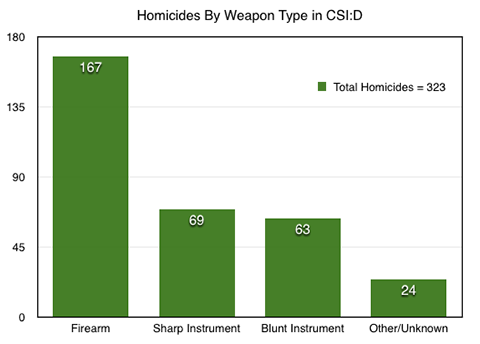
Today, the typical homicide in the United States involves one man shooting another, and this is equally true in the CSI:Dixie database. Comparatively speaking, the CSI:D sample has a higher percentage of male victims and a lower percentage of gun use. Today firearms are used in 68% of American homicides; in the CSI:D sample guns are used 52% of the time. Today 77% of homicide victims are male; in the CSI:D sample 88% are male (and virtually all of the perpetrators are men). Put bluntly, in the nineteenth century south, violent death was a more exclusively male province, and Death had more faces.
Interestingly, though, in the CSI:D database virtually none of the gun-related homicides are related to robbery. Most are the product of the highly combustible combination of anger and alcohol. The last words of J. Edward Sims were typical: “Shoot you damed cowardly son of a Bitch.” Or take this poignant exchange:
Tom Rutland (firing): “I will kill you, you son of a bitch.”
William Padgett (bleeding): “You have already.”
In the strange alchemy of the male brain, friends became mortal enemies in an instant, often over trivialities. “How in the hell did you Gap up My ax?” Gus Settler demanded to know of Allen Holmes in March 1882. I hardly know what a gapped-up axe looks like, but I do know that returning a borrowed tool in less than satisfactory condition is no grounds for murder. Settler disagreed and shot Holmes dead.
Infanticide
Life in the Faulknerian world of CSI:D was especially cheap for children. Catherine Berry, a domestic in the R. C. Poole household, was told that she would be terminated if she was indeed pregnant. In an awful feat of endurance, she continued with her chores until, doubled over with pain, she snuck away to give birth in the potato shed. Reeling from the loss of blood, she still managed to strangle the baby and fling it into the Pacolet River, where it washed up at the feet of some fishermen. When Peggy Bedenbaugh felt her first contractions, she went out to a corner of the yard, gave birth in a hole, and covered the baby over with dirt. Luly Collins threw her baby down a well. Nancy Owens swept hers under a brush pile. All had denied for months that they were in the “family way”; all had killed the evidence; all were indicted for murder.
Or take the case of Jane Arnold. On September 7, 1857, Brazeal Cox and his wife found sixteen-year-old Jane Arnold stretched out on the ground with a baby beside her, bleeding from its umbilical cord. When Arnold became aware of the couple she called out to Mrs. Cox, who wrapped the dying infant in Arnold’s apron and took it into the Arnold home. Mrs. Cox then returned and asked the girl why she hadn’t given birth indoors. Because her daddy was “doging” her, she said, and had cast her from the house. “She seemed to be grieving,” Cox told the coroner in a model of understatement, “but [I] don’t know what for, whether on the part of her dead child or the abuse of her father.”
Three years later, at four in the morning, a shivering Jane Arnold knocked at the door of a neighboring farm. She was cold and unkempt, but she couldn’t make up her mind to stay. Instead she returned to the abandoned schoolhouse where she had taken her latest baby, born in the middle of the road, to die of exposure.
The coroners’ office reveals a world where men force women into sex and women pay the price for it, in embarrassing pregnancies, social stigma, and the occasionally desperate attempt to cover up the evidence. In 1829 a fire in Thomas Welsh’s smoke-house revealed a small cubby in which a full term child had been secreted in a jar of lime. It is impossible to know whether this was an infanticide or a child who had been stillborn. Regardless the mother was covering up something. Occasionally that something was an interracial liaison. More often it was simply a pregnancy out-of-wedlock. Many of the cases reveal that the women had been trying for some time to induce an abortion. ‘Home remedies’ for pregnancy mentioned in the CSI:D sample include savin powder mixed with turpentine, red bark bay tea, and the ashes of dried corn cobs. In this sense some of the infanticides might be considered extremely late-term abortions. One unnamed mother, for instance, gave birth to a stillborn child who bore unmistakable marks of abuse en utero. M. Lipscomb was found doubled over a fence having apparently bled out in a botched, self-induced abortion.
Almost sadder is the number of women who were held to account for the ‘murder’ of infants who had most likely died of crib death or SIDS. Often sent back to the cotton field within days of giving birth, enslaved mothers were understandably exhausted, and they often slept with their infants so they could breast feed in a haze and go back to sleep. When they occasionally awoke to dead babies, they were unfortunately as susceptible as their doctors and enslavers to believe that they had smothered their children in their sleep, a phenomenon which only enhanced their reputation as uncaring and unnatural mothers.
NEXT: Suicide
Murder Cases Tried in South Carolina, 1887-1900
| Year | Number of Homicides Tried | Not Guilty Verdicts | Guilty Verdicts | Cases Dismissed or Continued | Percentage Found Guilty |
|---|---|---|---|---|---|
| 1887 | 79 | 54 | 11 | 14 | 13.9% |
| 1888 | 117 | 61 | 36 | 20 | 30.1% |
| 1889 | 120 | 69 | 30 | 21 | 25.0% |
| 1890 | incomplete returns | - | - | - | - |
| 1891 | 151 | 76 | 46 | 29 | 30.0% |
| 1892 | incomplete returns | - | - | - | - |
| 1893 | incomplete returns | - | - | - | - |
| 1894 | incomplete returns | - | - | - | - |
| 1895 | 210 | 112 | 67 | 31 | 31.9% |
| 1896 | 201 | 110 | 67 | 24 | 33.3% |
| 1897 | 215 | 120 | 64 | 31 | 29.7% |
| 1898 | 248 | 105 | 96 | 47 | 44.0% |
| 1899 | 205 | 83 | 97 | 35 | 47.3% |
| 1900 | 224 | 127 | 71 | 26 | 31.7% |
Credit: John Hammond Moore, Carnival of Blood: Dueling, Lynching, and Murder in South Carolina, 1880-1920 (Columbia: University of South Carolina Press, 2006), pp. 130-131, taken from Reports and Resolutions of the General Assembly of the State of South Carolina
Homicide Inquests
| Name | Deceased Description | Date | Inquest Location | Death Method | Inquest Finding |
Child |
|---|---|---|---|---|---|---|
| Dave Gillam | August 25, 1892 | at the house of Cal Smiths, Edgefield County, SC |
the Said Dave Gillam Came to his death from a gun Shot wound inflicted by the hands of Eliott Johnson |
|||
| Frank Dillard | September 24, 1890 | on the plantation of William Patterson, Laurens County, SC |
upon their oaths do say that the said Frank Dillard came to his death by "a gun shot wound in the hands of W.B. Patterson |
|||
| W. C. Benson | October 25, 1889 | at the police station in Spartanburg City, Spartanburg County, SC |
upon their oaths do say that the decased came to his death by a supposed fall from a trestle ... said fall causing concussion of the brain |
|||
| James Booth | August 23, 1878 | at E. C. House, Edgefield County, SC |
upon their oaths do Say that the said Jas Booth. . .came to his death by pistol Shots from the hands of parties unknown |
|||
| John Rhodes | July 13, 1853 | at Feathery Bay, Horry County, SC |
upon their oaths do say that Although it appears that the said John Rhodes has been missing ever since the day before Fall Court 1852, yet there is no proof to them that the said John Rhodes has ever been murdered |
|||
| Eddie Sellers | November 2, 1899 | at Cheraw, Chesterfield County, SC |
upon their oaths do say The deceased came to his death from a Pistol shot round in the hands of parties unknown to the Jury |
|||
| Frank Flowers | January 31, 1921 | [no location given], Chesterfield County, SC |
We the Jury . . . find that the Said Frank Flowers came to his death by gun Shot in the had of Dan Bittle |
|||
| Bill Reese | December 12, 1872 | at Pendleton, Anderson County, SC | knife |
do say that Bill Reese came to his death from a wound inflicted by a knife held in the hands of Sam Minse[?] |
||
| Isaac Salter | June 7, 1872 | at the old Colemans Quarter, Laurens County, SC | pistol |
upon their oaths do say that Isaac Salter came to his death, upon their oaths do sayeth by a pistol shot in the hands of Amos Anderson |
||
| Eldred Glover | March 2, 1852 | at the house of John Doby, Edgefield County, SC | pistol |
upon their oaths do say that the said Eldred Glover came to his Death . . .by a pistol ball passing through the abdomen fired from a pistol in the hand of Dr. Walker Samuel |
||
| Fanny | slave | November 4, 1855 | at the plantation of Edward A. Salmond about four miles from Camden, Kershaw County, SC |
do say that that the Negro woman came to her death by a fit of apoplexy on the morning of the fourth day of November 1855 in her own house. |
||
| Bertha Evans | August 11, 1941 | at Chesterfield, Chesterfield County, SC |
upon their oaths do say that Farquer Ratliff & Bertha Evans received in Chesterfield County a mortal wound by Gun shot wounds in the hands of James Evans |
|||
| Prince | slave | January 15, 1865 | at John Seiglers, Edgefield County, SC | knife |
upon there oaths do say that the boy Prince came to his death by a stab with a knife or some sharp pointed instrument in the hands of Jef a slave of John Seiglers |
|
| George W. Barker | December 27, 1854 | at Winnsboro, Fairfield County, SC |
upon their oaths do say That the deceased came to his death by pistol shots, received in an affray between the deceased and Richard N. McMaster, from a pistol fired in the hands of Richard N. McMaster on the night of the 26th. |
|||
| Joe Weston | January 31, 1895 | in Edgefield County, Edgefield County, SC |
upon their oaths do say, that the said Joe Weston aforesaid came to his death from gun shot wounds in the hands of parties to us unknown |
|||
| Unknown Infant | Unknown Infant | April 8, 1873 | at Martins Depot, Laurens County, SC |
upon their oaths aforesaid do say, that the aforesaid Infant came to its death by the hands of Rebecca East, against the peace and dignity of the same state aforesaid. |
||
| William Owens | May 28, 1859 | at Wm Owens, Laurens County, SC | stick |
upon their oaths do say that Wm Owens came to his death by blows inflicted upon his face neck and head with a large stick in the hands of Thomas Owens on the evening of the 18th day of May 1859 |
||
| Rachel | slave | November 2, 1838 | at the House of Samuel L Martin, Union County, SC | ax |
do say oppon their oaths that wone negro woman name Clansy propperty of Samuel Martin not having got Before his Eyes Being moved and seduced by the instigation of the devil . . .with force and arms . . .with a sertain ax did then and there vilently and feloniously with malice of forethough strike and pierce and give to the said Rachel with the said ax in and uppon the front as well as the Back part of the head two mortal wounds |
|
| Sam Sinclair | slave | March 24, 1820 | at John Chesnut plantation near Chesnut's Ferry on Wateree River, Kershaw County, SC |
do say upon their oaths that the said Negro man slave the property of John Chesnut son of James Chesnut Esquire was violantly [sic] Murdered |
||
| William Martin | May 24, 1891 | on the premises of W. E. Friday, Edgefield County, SC | pistol |
upon their oaths do say that the deceased Wm Martin came to his death from a pistol shot wound and that Augustus Dearing firered the pistol |
||
| Will Simpson | July 30, 1894 | at Ella Nelson's residence, Laurens County, SC |
upon their oaths do say that Will Simpson came to his death by a pistol shot on the 29th day July 1894 at the house of Ella Nelson, by W.H. Henderson in self defence and the verdict of the jury is justifiable homicide. |
|||
| A. G. Douglass | May 6, 1889 | at A. G. Douglass', Chesterfield County, SC |
upon their oaths do Say that the Said A.G. Douglass came to his death By a gunshot wound in the hands of W. D. Merriman and A. B. Merriman Bill Merriman & James Pegg Being Acessors to the crime |
|||
| Leonard Dixon | October 27, 1934 | at Chesterfield, Chesterfield County, SC | shotgun |
upon their oaths do say that Leonard Dixon received in Chesterfield County a mortal wound by Shot gun in the hands of Frank DeBerry on the 26 day of October 1934, and that form such mortal wound deceased died in South Carolina on October 26-1934. |
||
| William Thurmond | February 14, 1856 | at Edgefield Court House, Planters[?] Hotel, Edgefield County, SC | chair |
upon their oaths do say, that he the deceased was Killed, by a blow with a chair, in the hands of William P Jones ... inflicted on the head |
||
| Eisex Brown | February 12, 1869 | at John Canty's plantation, Kershaw County, SC | stick |
upon their oaths do say that the said Eisex Brown came to his death from two blows upon the head inflicted with a stick in the hands of Friendly Gowdin [?] |
||
| Flora Harrison | November 4, 1890 | at Liberty Hill, Edgefield County, SC |
upon their oaths do say that Sam Moss the Said Flora Harrison by Misfortune and contrary to his Will in manner and form aforesaid did Kill and Slay |
|||
| Woodward | June 9, 1879 | on the road leading from Dantzler's Bridge on South Tyger River via G. W. Duncan's and R. T. McElvath's to Reidville, Spartanburg County, SC |
upon their oaths do say that ... the deceased came to her death by gunshot wound in the Breast, and incised wound on the neck, which severed the carotid arteries, windpipe, and other vital organs, and that we believe the said wounds were inflicted by weapons in the hands of John J. Moore |
|||
| Louisa Laudon | October 11, 1869 | at Dorns Steam Mills near Rocky Creek, Edgefield County, SC | knife |
upon their oaths do say That Louisa Laudon came to her death by a knife in the hands of some person or persons unknown |
||
| William Rosborough | at Winnsboro, Fairfield County, SC |
upon their oaths do say, that that the said William Rosborough was willfully, unlawfully and maliciously killed by a gun shot wound and that he was willfully killed and murdered[.] |
||||
| Jim McKie | October 26, 1898 | near John starks, Edgefield County, SC |
do say that Jim McKie came to his death from gun shot wounds in the hands of some unknown parties |
|||
| Edgar Kelly | December 27, 1913 | at Colan Herdon's, Chesterfield County, SC |
upon their oaths, do say: Edgar Kelley came to his death by Knife wounds in the hand of Neal Hendrix |
|||
| Thomas W. Harrison | November 23, 1860 | At Pendleton, Anderson County, SC | pistol |
do say that the deceased was killed by a pistol shot, fired by Francisco Tapapso[?], at Pendelton. |
||
| Arch | September 4, 1864 | at SR Todds plantation, Laurens County, SC |
upon their oaths do say that he came to his death by a gun shot wound, by M.P. Traynham in self defence at SR Todds plantation about one oclock the 3rd Sept Inst AD 1864. |
|||
| Baby Boatwright | February 26, 1937 | at Jefferson, Chesterfield County, SC |
upon their oaths do say that Baby Boatwright received in Chesterfield County a mortal wound by a stick in the hands of Gertrude Boatwright |
|||
| Jasper Deal | January 18, 1880 | at Greenville, Greenville County, SC | pistol |
upon their oaths do say that . . .the said Jasper Deal came to his death from the effect of a pistol shot wound in the hands of Henry Townsend. The ball entering the head just below the left eyebrow and passing directly through the brain to the back of the head. |
||
| Isaah Golden | August 27, 1860 | at Silverton Beach iland, Edgefield County, SC | knife |
upon there oaths do say that the deceased Came to his death. . .by John Williams sen and John Williams Jr that they did feloniously killed the deceased Isaah Golden with a knife |
||
| Allen | slave | September 19, 1843 | at Samson Bobo's, Spartanburg County, SC | hickory clubs |
upon their oaths do say that the said Allen. . . was killed and murdered by some person or persons to the jurors unknown with two hickory clubs |
|
| Charles Cobb | March 13, 1893 | at or near Johnston, Edgefield County, SC | umbrella |
upon their oaths do say. . .that Charles Cobb, did come to his death. . .from injuries inflicted by the hands of one Thomas Cherry, with an umbrella |
||
| Jno Fuller | October 6, 1890 | on the plantation of Melmoth Hooker, Laurens County, SC |
by their oaths do say that the said Jno Fuller came to his death "From Gun Shot wounds in the hands of Perry Gray without cause." |
|||
| Joseph Burgess | boy | October 16, 1824 | at the premises of Mrs. Hales[?], Union County, SC | gun |
say upon their oaths the said Joseph Burgess in manner and form came to his death by a stroke or blows withs with a gun across his right ear and the back part of his head. Supposed to have been effected from every circumstance in our view by George McKnight |
|
| Henry Turner | September 24, 1878 | at Johnstons, Edgefield County, SC |
upon their oath do say that the said Henry Turner came to his death by a pistol or gun shot from the hands of Cato[?] Butler |
|||
| Elizabeth M. Skipper | June 5, 1857 | at the House of Abraham B. Skipper, Horry County, SC |
upon their Oaths do say, That the said Elizabeth M. Skipper, was killed and murdered by some person or persons to the Jurors unknown |
|||
| D. M. Pettit | December 19, 1899 | at G.J. Redfern, Chesterfield County, SC |
upon their oaths, do say: we the jurors find that D M Pettit came to his death by a wound on left side of his head causing fracture of the skull and depression on the brans in some manner unknown to the jury |
|||
| Will Johnson | August 16, 1931 | at Ingram's Mill, Chesterfield County, SC |
do upon oath say that Will Johnson came to his death by gunshot wound in the hands of Alex Brown. |
|||
| Robert H. Pettigrew | December 27, 1872 | at James H. Wiles house, Anderson County, SC | knife |
do say from a wound on his left side between the second and eight ribs penetrating to the. . .by a knife |
||
| Aaron McMahan | October 14, 1872 | at Eden, Laurens County, SC | knife |
upon their oaths do say that the said Aaron McMahan came to his death by means of a dirk knife in the hands of John Kellett at or near Eden |
||
| Aaron | slave | December 5, 1852 | at A. Bushnells Shop, Edgefield County, SC | chisel |
upon their oaths do say that said Negro slave Aaron was Feloniously Killed . . .by a stab on the left side of the throat with a chissel about one inch and a half wide, by the hand of some person unknown |
|
| William | slave | November 10, 1856 | near Prospect Church near the line of Richland and on the waters of Wayland's Creek, Kershaw County, SC |
do say that the said negro man William came to his death from a wound in the back caused by a shot gun in the hands of some person or persons to the jurors unknown |
||
| David Cornelius Boan | January 18, 1943 | at Cheraw, S.C., Chesterfield County, SC |
upon their oaths do say that David Cornelius Boan received in Chesterfield County a mortal wound by Shot gun in the hands of Hiram Mareen Linton |
|||
| Sam Howard | Freedman | August 6, 1866 | at L. L. Halls, Edgefield County, SC | knife |
upon there oaths do say that Sam Howard Freedman Came to his death. . .by a stab with a knife or some sharp pointed instrument in the hands of John Daniel Freedman |