

Homicide
In 1827, a slave named Ambrose escaped from his owner Berryman Burger. Like most runaways, Ambrose did not make the dangerous trek north but remained in the area, a practice called ‘lying out.’ In most cases, such slaves kept a low profile, living off the land or from scraps gleaned from friends and compatriots in the quarter. Ambrose, however, took a different path, waging guerrilla war against slavery and local slaveholders. Over the course of more than a year he broke into barns, slaughtered hogs and poultry, pillaged smokehouses, burned outbuildings, destroyed cotton, and generally behaved like a local Robin Hood, stealing from the rich and returning to his fellow slaves. Within months, Ambrose had induced other runaways to join him, and he was regarded by local planters as a “desperate character ... capable of any act of villainy” who should be killed on sight.
Early in the morning of September 24, 1828, a local white man, Kirkland Harmon, surprised Ambrose in his camp and gunned him down as he rose. Ambrose winced as the buckshot “enter[ed] his back loins & hips,” and he bled out on the ground. His one-man rebellion was effectively over. Without the coroner’s inquest convened over his body, however, we would know nothing of his rebellion; the record of his death is the only record we have of his life. How many Ambroses were there? It is hard to know. To its credit, Ambrose’s band picked up his mantle and continued to operate in the area as a plague to local planters.
I was not surprised to learn that such local resistance was quashed and that slaves like Ambrose were routinely murdered. I was surprised to learn how often the coroner responded. In her WPA interview, the former slave Mittie Freeman remembered the coroner as “that fellow that comes running fast when somebody gets killed,” and the coroner is mentioned in quite a few of the most famous slave narratives, including those by Frederick Douglass and William Wells Brown. The coroner was often the only magistrate mentioned because he was the only ‘outside’ law the slaves ever saw. We will never know precisely how many enslavers murdered their slaves and effortlessly covered it up. But in cases where the murderer was someone other than the enslaver, or where the enslaver failed to cover it up, there usually was an investigation, at the very least because property had been destroyed, and someone expected compensation.
Reflecting on the South he was forced to flee because of his Unionism, John Aughey noted: “Of course the laws which exist in every state against the murder or torturing of slaves are about as well observed as might be laws enacted by wolves against sheep-murder.” But in the coroners’ inquest there was actually a subtle game of community standards going on. Standing over the body of a slave and surveying the grim damage, a coroner’s jury was often perfectly comfortable recommending that a white be indicted. And at coroner’s inquests slaves were allowed to testify. The actual jury nullification came later, in the courtroom, when the mangled body was not actually present and the murderer was let off. But by then he had been held up to public scrutiny; his judgment and decency had been questioned publicly and legally. It is less than justice, but it is not nothing, a fact which slaves themselves recognized. When the coroner came a-runnin’, many slaves thought he might bring justice with him from some far off, saner place. And in his own Narrative, Frederick Douglass tells the story of an unnamed slave girl whose mistress “pounded in her skull” with a piece of firewood because she allowed a baby to cry uncontrollably and wake the household. “I will not say that this murder most foul produced no sensation. It did produce a sensation. A warrant was issued for the arrest of Mrs. Hicks, but incredible to tell, for some reason or other, that warrant was never served, and she not only escaped condign punishment, but the pain and mortification as well of being arraigned before a court of justice.” It is hard to believe that for all he’d seen of the institution of slavery, Douglass still thought it capable of any justice at all.
What does not make it into many of the slave narratives, including Douglass’s, is the violence that existed within the slave community. Enslavement does not magically transform all who endure it into savvy, self-sustaining freedom-fighters. If we are going to grant the enslaved their full humanity we must grant that, like any other group of people, they occasionally fought, fornicated, and got into petty disputes that sometimes took a murderous turn. To be sure, as historian Steven Hahn has noted, the slave quarter produced one of the most radical and transformative politics ever seen in America, a politics that produced Nat Turner and Frederick Douglass and finally brought down a $3.5 billion dollar interest. But in coroners reports we get a glimpse of the violence that existed within the slave community that we knew had to be there. Thus did the enslaved of the Haile plantation turn their children over to Tamer, the enslaved nurse, on their way out to the fields, little knowing that she liked to punish the children by tying them too close to a fire, a practice that was only discovered when she finally cooked one of them to death. Or take the case of an enslaved man named Dick who became so jealous that he pulled a log from a fire and murdered the man who was staying in the cabin of a woman he wanted to sleep with.
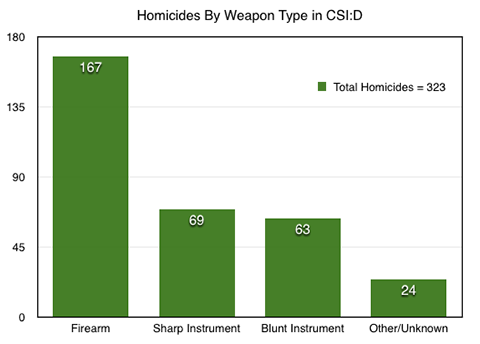
Today, the typical homicide in the United States involves one man shooting another, and this is equally true in the CSI:Dixie database. Comparatively speaking, the CSI:D sample has a higher percentage of male victims and a lower percentage of gun use. Today firearms are used in 68% of American homicides; in the CSI:D sample guns are used 52% of the time. Today 77% of homicide victims are male; in the CSI:D sample 88% are male (and virtually all of the perpetrators are men). Put bluntly, in the nineteenth century south, violent death was a more exclusively male province, and Death had more faces.
Interestingly, though, in the CSI:D database virtually none of the gun-related homicides are related to robbery. Most are the product of the highly combustible combination of anger and alcohol. The last words of J. Edward Sims were typical: “Shoot you damed cowardly son of a Bitch.” Or take this poignant exchange:
Tom Rutland (firing): “I will kill you, you son of a bitch.”
William Padgett (bleeding): “You have already.”
In the strange alchemy of the male brain, friends became mortal enemies in an instant, often over trivialities. “How in the hell did you Gap up My ax?” Gus Settler demanded to know of Allen Holmes in March 1882. I hardly know what a gapped-up axe looks like, but I do know that returning a borrowed tool in less than satisfactory condition is no grounds for murder. Settler disagreed and shot Holmes dead.
Infanticide
Life in the Faulknerian world of CSI:D was especially cheap for children. Catherine Berry, a domestic in the R. C. Poole household, was told that she would be terminated if she was indeed pregnant. In an awful feat of endurance, she continued with her chores until, doubled over with pain, she snuck away to give birth in the potato shed. Reeling from the loss of blood, she still managed to strangle the baby and fling it into the Pacolet River, where it washed up at the feet of some fishermen. When Peggy Bedenbaugh felt her first contractions, she went out to a corner of the yard, gave birth in a hole, and covered the baby over with dirt. Luly Collins threw her baby down a well. Nancy Owens swept hers under a brush pile. All had denied for months that they were in the “family way”; all had killed the evidence; all were indicted for murder.
Or take the case of Jane Arnold. On September 7, 1857, Brazeal Cox and his wife found sixteen-year-old Jane Arnold stretched out on the ground with a baby beside her, bleeding from its umbilical cord. When Arnold became aware of the couple she called out to Mrs. Cox, who wrapped the dying infant in Arnold’s apron and took it into the Arnold home. Mrs. Cox then returned and asked the girl why she hadn’t given birth indoors. Because her daddy was “doging” her, she said, and had cast her from the house. “She seemed to be grieving,” Cox told the coroner in a model of understatement, “but [I] don’t know what for, whether on the part of her dead child or the abuse of her father.”
Three years later, at four in the morning, a shivering Jane Arnold knocked at the door of a neighboring farm. She was cold and unkempt, but she couldn’t make up her mind to stay. Instead she returned to the abandoned schoolhouse where she had taken her latest baby, born in the middle of the road, to die of exposure.
The coroners’ office reveals a world where men force women into sex and women pay the price for it, in embarrassing pregnancies, social stigma, and the occasionally desperate attempt to cover up the evidence. In 1829 a fire in Thomas Welsh’s smoke-house revealed a small cubby in which a full term child had been secreted in a jar of lime. It is impossible to know whether this was an infanticide or a child who had been stillborn. Regardless the mother was covering up something. Occasionally that something was an interracial liaison. More often it was simply a pregnancy out-of-wedlock. Many of the cases reveal that the women had been trying for some time to induce an abortion. ‘Home remedies’ for pregnancy mentioned in the CSI:D sample include savin powder mixed with turpentine, red bark bay tea, and the ashes of dried corn cobs. In this sense some of the infanticides might be considered extremely late-term abortions. One unnamed mother, for instance, gave birth to a stillborn child who bore unmistakable marks of abuse en utero. M. Lipscomb was found doubled over a fence having apparently bled out in a botched, self-induced abortion.
Almost sadder is the number of women who were held to account for the ‘murder’ of infants who had most likely died of crib death or SIDS. Often sent back to the cotton field within days of giving birth, enslaved mothers were understandably exhausted, and they often slept with their infants so they could breast feed in a haze and go back to sleep. When they occasionally awoke to dead babies, they were unfortunately as susceptible as their doctors and enslavers to believe that they had smothered their children in their sleep, a phenomenon which only enhanced their reputation as uncaring and unnatural mothers.
NEXT: Suicide
Murder Cases Tried in South Carolina, 1887-1900
| Year | Number of Homicides Tried | Not Guilty Verdicts | Guilty Verdicts | Cases Dismissed or Continued | Percentage Found Guilty |
|---|---|---|---|---|---|
| 1887 | 79 | 54 | 11 | 14 | 13.9% |
| 1888 | 117 | 61 | 36 | 20 | 30.1% |
| 1889 | 120 | 69 | 30 | 21 | 25.0% |
| 1890 | incomplete returns | - | - | - | - |
| 1891 | 151 | 76 | 46 | 29 | 30.0% |
| 1892 | incomplete returns | - | - | - | - |
| 1893 | incomplete returns | - | - | - | - |
| 1894 | incomplete returns | - | - | - | - |
| 1895 | 210 | 112 | 67 | 31 | 31.9% |
| 1896 | 201 | 110 | 67 | 24 | 33.3% |
| 1897 | 215 | 120 | 64 | 31 | 29.7% |
| 1898 | 248 | 105 | 96 | 47 | 44.0% |
| 1899 | 205 | 83 | 97 | 35 | 47.3% |
| 1900 | 224 | 127 | 71 | 26 | 31.7% |
Credit: John Hammond Moore, Carnival of Blood: Dueling, Lynching, and Murder in South Carolina, 1880-1920 (Columbia: University of South Carolina Press, 2006), pp. 130-131, taken from Reports and Resolutions of the General Assembly of the State of South Carolina
Homicide Inquests
| Name | Deceased Description | Date | Inquest Location | Death Method | Inquest Finding |
Child |
|---|---|---|---|---|---|---|
| Levi H. McDaniel | March 9, 1859 | at or near the 17 mile Post on the Scotts Ferry Road, Edgefield County, SC |
upon there oaths do say that. . .the deceased came to his death by a Pistol shot in the left side near the region of the heart fired from the hands of one James H. Jones |
|||
| William Milligan | June 7, 1852 | at Conway borough, Horry County, SC |
upon their oaths do say that we believe he came to his death by wounds inflicted in the throat, and in the Stomach by a Knife in the hands of Absalom Causey |
|||
| John Pettigrew | January 17, 1843 | at the Irish buying ground, Kershaw County, SC | knife |
upon their oaths do say that on the 27th day of last December one Bennett Dozier of Kershaw District did wound with a knife the deceased John Pettigrew of Kershaw District so as to cause his, John Pettigrew's death on Sunday the first day of January |
||
| Gus Blocker | August 18, 1892 | at the plantion of July Blocker, Edgefield County, SC |
upon their oaths do Say that the Said Gus Blocker came to his death by a gun Shot in the hands of one Isiac[?] Blocker |
|||
| Robert Harris | September 13, 1870 | at Laurensville, Washington Ferguson's house, Laurens County, SC | pistol |
upon their oaths do say that the aforesaid Robert Harris came to his death on this 5th Sept. 1870 at the house of Washington Ferguson, in County and State aforesaid, by a pistol shot from a pistol held in the hands of Jeff Fuller. |
||
| Gabavila Steadman | May 15, 1889 | at Joseph Stedman's, Spartanburg County, SC |
upon there oaths do say that the said Gabriella Stedman came to her death by blows inflicted on the head by person or persons unknown to the jury |
|||
| A. G. McDonald | March 11, 1927 | at Cheraw, Chesterfield County, SC | ax |
upon their oaths, do say: we the jury find that the deceased A.G. McDonald came to his death by being struck on the head by an ax in the hands of Will Alias Man Dawkins and we recommend that Katie Howard be heald as an accessory before and after the fact |
||
| Thomas Booth | August 23, 1878 | at E. C. House, Edgefield County, SC | pistol |
upon their oaths do Say that the said Thos Booths. . .came to his death by pistol Shots from the hands of parties unknown |
||
| Willis | slave | October 5, 1847 | at James Burnett's, Spartanburg County, SC | rock |
upon their oaths do say he came to his death by a wound with a rock in the forehead at the camp meeting at Prospect[?] by the hands of Dave belonging to John Liles of Polk County, N.C. |
|
| Amaziah Payton | colored man of New York | July 20, 1866 | at the house of Richmond Payton, Anderson County, SC | pistol |
do say that the aforesaid Amaziah Payton came to his death. . . from the effects of a wound a little above the left groin, suppose to have been made by a pistol ball?.which ball was shot from a pistol which one Reuben L. Golding then and there had and held |
|
| G. B. Kelly | December 16, 1896 | at Chesterfield Court House, Chesterfield County, SC |
upon their oaths, do say: That the said G.B. Kelly came to his death from a gun shot wound on the 12th day of Dec. 1896 in the hands of W.P. Swinnie and died on the 14th of Dec from the effects |
|||
| Aaron | slave | December 3, 1851 | at the house of Larkin Swearinghim, Edgefield County, SC | cow hide |
upon their oaths do say, that we believe the said Aaron came to his death by a whipping recd by the hands of Chesley B. Wise with a cow hide, aided by Edmund Kennedy |
|
| Mose Lowery | March 16, 1940 | at Chesterfield, S. C., Chesterfield County, SC | pocket knife |
upon their oaths do say that Mose Lowery received in Chesterfield County a mortal wound by pocket knife in the hands of unknown hands |
||
| William Leak | October 11, 1812 | at Brant Leaks, Laurens County, SC | knife |
do say upon our oathes that the said William Leak came to his death on the sixteenth day of October one thousand eight hundred and twelve when on his way home from his Fathers House to shoot near the House of Lewis D Yancys he then and there recivd a stab in his left thight with a large Knife by Samuel Yancy of which wound he instantly Deceased and we do further say that the aforesaid Samuel Yancy did notoriously and willfully perpetrate the said murder on the body of the said Decd against the peace of this state. |
||
| Robert J. Butler | September 15, 1864 | at Hamburg, Edgefield County, SC |
upon there oaths do say that Robert J Butler sen[?] came to his death by gun shot wound inflicted by Doct J D Twiggs |
|||
| Haywood Barksdale | May 11, 1893 | near A.H. Martin's, Laurens County, SC |
upon their oaths do say that he came to his death in Laurens Counrt on the 10th day of May 1893 from strangulation by being hung by the neck, by parties unknown to the jury. |
|||
| Jim | slave | June 19, 1858 | at the plantation of A.H. Boykin, Kershaw County, SC |
upon their oaths do say that the said negro Jim came to his death. . .from three wounds inflicted on and across the face by some weapon or instrument to the jury unknown in the hands of Dick a slave of William Sanders |
||
| Will Collens | October 20, 1894 | at Gaines SC, Edgefield County, SC |
upon their oaths do say, that the said Will Collens came to his death by gun shot wound by the hands of Jack Harrison |
|||
| George Prisock | June 11, 1840 | at E. P. Porters, Union County, SC | hoe |
upon their oaths do say that the said George Prisock, was Struck one violent blow with a weading[?] hoe on the head which broke his skill, the above blow was Struck by a negro man Slave name James, the property of E. P. Porter |
||
| Angie Bell Crawford | October 6, 1933 | near Pageland, Chesterfield County, SC |
upon their oaths do say that We the Jury find that Angie Bell Crawford came to her death by Natural Causes. |
|||
| Giles Guess | colored | February 2, 1882 | at the hosue of John Smith, Anderson County, SC | pistol |
do say that the deceased was willfully killed by the hand of one Isaac Putnam by shooting deceased with a pistol and that Silas Putnam was accessory to the killing about seven or eight oclock in the afternoon at the house of one John Smith |
|
| W. H. H. Richards | February 1, 1884 | at Cheraw, Chesterfield County, SC |
upon their oaths, do say: That the said W.H.H. Richards came to his death by a pistol shot, received on 23rd July 184, at the hands fo W B Cash |
|||
| Sylvester Streater | August 18, 1947 | at Chesterfield, S. C., Chesterfield County, SC |
upon their oaths do say that Sylvester Streater received in Chesterfield County a mortal wound by 38 Pistol in the hands of Thelma Williams Streater |
|||
| Cesar | Negro, negro boy | July 7, 1843 | at the house of Elijah Watson, Edgefield County, SC |
upon their Oaths do say. . .believe said negro came to his death by a sever blow given him by Jerry one of said Watsons negroes not with the intention to Kill |
||
| James Walls | at the Tevin Pines', Fairfield County, SC | baseball bat |
upon their Oaths do say the deceased came to his death at Ware's base ball ground, the 5th of Sept 1891 from a blow on the head with a base ball bat in the hands of Charles Young. |
|||
| Captain | slave | January 24, 1824 | at plantation of Captain John Boykin, Kershaw County, SC | knife |
do say upon their oaths that they are of opinion that the deceased was killed on the morning fo the 21st January 1824 between daylight and sun rise with a knife being cut upon the chin and stabbed in the upper part of the right breast near the collar bone and so jurors conclude that the deceased was feloniously killed by some person unknown |
|
| Andy Padgett | July 5, 1891 | near Ridge Spring, Edgefield County, SC | knife |
upon their oaths do say that. . .was deceased stabbed to death With a Knife in the hands of one[?] Rufus Dent |
||
| John Nickle | October 30, 1853 | at the House of David Owens, Laurens County, SC | whip |
upon their oaths do say That after having the body of the Decd. John Nickle exposed & after examining the body & all the circumstances that the sd. John Nickle came to his death from a severe whipping inflicted upon the body of the sd. Decd. On the 24th of October Inst (Monday) about 3 or oclk in the afternoon by William Hazle of the state & District aforesaid and that the said whipping as proven by witnesses examined & as exhibited upon the body as exposed to the undersigned, was inflicted... willfully by the sd. William Hazel against the peace the humanity & dignity of the same State aforesd. This Inquest concur in the opinion that as before stated that as the sd. Decd. John Nickle was but a youth - he being about six years of age - his health at the time of the infliction of the whipping as before state being feeble, & suffering with disease are of opinion that the diseased health of the boy & the whipping as a secondary cause... |
||
| Rufus Yarbrough | March 17, 1872 | at the residence of John Davis Esqr., Spartanburg County, SC | pole axe |
upon their oaths do say that in their opinions the said deceased came to his death at the place where found, viz. in front of corn crib on the premises of John Davis Esqr., caused by a blow on the neck severing the jugular vein and windpipe with a pole axe in the hands of some unknown person |
||
| Andrew Moore | August 10, 1889 | at Samson Simons', Chesterfield County, SC |
upon their oaths do say that the said Andrew Moore did come to his death by a Knif in the hand of Robert Moore by inflicting a wound with said Knif in the Regions of the heart |
|||
| Charles M. Creswell | August 5, 1869 | at Edgefield CH, Edgefield County, SC |
the said Charles M Creswell came to his death do say that . . .the deceased Charles M Creswell came to his death by a gunshot wound from a gun in the hands of some person or persons unknown |
|||
| John Laudrum | October 11, 1869 | at Dons Steam Mills near Rocky Creek, Edgefield County, SC | knife |
upon their oaths do say: That he said John Landow[?] came to his death by stabs in the body from a knife in the hands of some person or persons unknown |
||
| George Grice | May 6, 1877 | at Doby's Mill, Kershaw County, SC | knife |
upon their oaths do say that George Grice came to his death by a stab wound in the left breast by a knife in the hands of George Philips[?] |
||
| nameless newborn boy or male child | nameless newborn boy or male child | January 12, 1885 | at T P Byrds Campbell place, Laurens County, SC |
upon their oaths do say that the said nameless boy or male child came to his death on the 10th day of January AD 1885 and in Laurens County by strangulation cause by criminal negligence on the part of Kittie F. Malone. |
||
| Alfred Hollingsworth | October 10, 1898 | at David Strothers place, Edgefield County, SC | razor |
upon their oaths do say, that Alfred Hollingsworth came to his death by a razor cut in the hands of George Hutcherson |
||
| John W. Buchanan | July 18, 1936 | at Cheraw, Chesterfield County, SC | rock |
upon their oaths do say that John W. Buchanan received in _____ County a mortal wound by Rock in the hands of Ed. Mack, Jr. |
||
| John Rowland | August 22, 1825 | at the Presbyterian Church known by the name of the Ebenezer meeting house, Fairfield County, SC | knife |
do say upon their oaths that one John Brown, late of the district aforesaid, on the 4th day of June 1825, did commit a violent assault on the said John Rowland by the infliction of two greivous and dangerous wounds on the body of the said John Rowland John Rowland died, on the 19th instant, then and there feloniously killed and murdered the said John Rowland against the peace of the said state. |
||
| Meredith Griffin | February 15, 1889 | at F D Hunters, Laurens County, SC |
upon their oaths do say That Turner Jones did discharge the contents of a shot gun in the body of Meridith Griffin thereby killing him about 8 Oclock on the Evening of the 14 Feb 1889. And the jurors aforesaid upon their Oaths do say the killing was done in self defence. |
|||
| George Franklin | of color | December 4, 1866 | at Hush[?] Creek, Greenville County, SC |
upon their oaths do say that. . . he came to his death by means of a gun shot which entered about five inches below the right nipple & passed out just above the left [?] bone at Thor[?] Callaway's still house |
||
| John M. Tillman | May 6, 1860 | at Mr J.A Tillmans Steam Mill, Edgefield County, SC |
upon there oaths do say that. . . J. M. Tillman was shot. . .with fire arm in the hands of George R Mays the Ball entering the brest neat the Pit of the Stomac Passing through the right side internily come near out under the right arm |
|||
| Michael Pertell | August 2, 1858 | at Conwayboro, Horry County, SC | knife |
upon their oaths aforesaid do say that the aforesaid Joseph J. Rollins feloniously did Kill against the peace and dignity of the same state aforesaid |
||
| Ann | slave | January 2, 1844 | at Capt. B. Haile's plantation, Kershaw County, SC |
do say that the little girl Ann, a slave the property of B. Haile, came to her death by being burnt intentionally by the nurse, Tamer, a slave of B. Haile. |
||
| Dave Gillam | August 25, 1892 | at the house of Cal Smiths, Edgefield County, SC |
the Said Dave Gillam Came to his death from a gun Shot wound inflicted by the hands of Eliott Johnson |
|||
| William Flemming | October 20, 1870 | at Laurens Court House, Laurens County, SC |
upon making view and inquests that the said William Fleming came to his death by gun shot would from guns that were in the hands of some person or persons unknown. |
|||
| W. C. Benson | October 25, 1889 | at the police station in Spartanburg City, Spartanburg County, SC |
upon their oaths do say that the decased came to his death by a supposed fall from a trestle ... said fall causing concussion of the brain |
|||
| Annie Streeter | July 12, 1919 | at a House in Chesterfield County, South Carolina, Chesterfield County, SC |
find that the said Annie Streeter came to her death by gun shot wound inflicted by Alexander Streeter |
|||
| James Booth | August 23, 1878 | at E. C. House, Edgefield County, SC |
upon their oaths do Say that the said Jas Booth. . .came to his death by pistol Shots from the hands of parties unknown |
|||
| Peter | slave | March 31, 1848 | at or near Calum Foster's[?], Spartanburg County, SC | rifle |
upon their oaths do say that he came to his death by the hands of C. Alexander being shot with a rifle ball through the head |
|
| John G. Gorley | July 26, 1866 | Anderson County, SC | rope |
the said John G. Gorly came to his death?by having been hanged by the nexck until his body was dead, by means of a certain of a certain grass rope fastened to the limb of a certain oak sapling near to the spot where the bones then lay....and that Henry J. Knauff of Pendleton village...and John Baskins and Thompson Oliver...did there and there feloneously hang and murder the said John G. Gorly |
||
| Eddie Sellers | November 2, 1899 | at Cheraw, Chesterfield County, SC |
upon their oaths do say The deceased came to his death from a Pistol shot round in the hands of parties unknown to the Jury |