
Accident
Accidents were the leading cause of death in the CSI:D sample, and drowning was the leading cause of death among mortal accidents. There are myriad reasons why. Broad swaths of the American public did not know how to swim. Primary modes of transportation, especially early in the century, involved river routes. Mill ponds were prevalent. Children played outside—generally a good thing but occasionally a sad one. Perhaps the saddest of these incidents involved a mass May Day drowning at Boykin Mill Pond in 1860. Twenty-eight teenagers set off on a raft that hit a snag and more than twenty-five drowned, including all five children from one family. Sadder still may be the case of Noah Wesley Dawkins. In mid-June 1888, Dawkins and his friends, all African Americans, set off for a local watering hole where they ran into three white boys, one of whom offered Dawkins fifty cents if he would walk into a particular area in the creek, assuring him it wasn’t deep. It was deep, and Dawkins drowned. It is tempting to classify this as a homicide, but it is clear from testimony that the white children thought they were playing a cruel trick, not a deadly one.
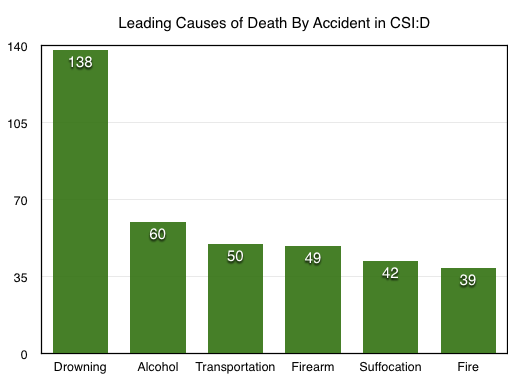
Alcohol was such a critical indirect cause in so many of the accidental drownings, shootings, fires, and falls in CSI:D that it really ought to be regarded the deadliest force in nineteenth century South Carolina. In addition to these indirect roles, alcohol was the direct cause of accidental death in more than sixty cases. It was probably also a direct cause in many of the ‘exposure’ cases—bodies that were discovered outside and were thought to have died from exposure to the elements.
Nineteenth century law enforcement had no recourse to blood-alcohol tests. Even today, determining precise BACs postmortem, and working back from those to levels of inebriation at time of death, is fraught with difficulty. This meant that nineteenth-century coroners had to rely exclusively on witness testimony and the known habits of the deceased to determine alcohol’s role in producing death. Standing around a dead man, jurors found themselves passing judgment on just how drunk he had been the night before. According to witnesses, John Goodlett “seemed to be drunk.” John Agner was “sorry he was drunk.” Abe Waganan was “very funny & lively”—very drunk as [was] his custom.” Is ‘very drunk’ drop-dead drunk? It is hard to know. On the night of January 15, 1816, Angus McQueen drank more than half a gallon of spirits. “The dec’d was very much intoxicated,” noted one witness, “and fell down four times during which time he vomited upon the carpet.” Because McQueen kept getting up and falling down, the jurors determined that the falls (and the winter cold) contributed to his demise, though it is equally possible that McQueen died of alcohol poisoning. Juries were more likely to fix upon ‘intemperance’ as a clear cause of death if the deceased was a notorious addict. In December 1842, H. P. Church was discovered by his land-lady sprawled half on and half off of his bed. A “habitual drunkard” who had been continuously drinking for two weeks, she did not even bother to try and shake him awake. The inquest did not hesitate in finding that Church had died of intoxication.
The third leading cause of accidental deaths were ‘vehicular’ accidents, a catch-all category that includes drunken falls from a train and sober buckings from a horse. Further complicating this picture is the fact that many of the drownings probably belong in this category. There is little difference between falling unwitnessed off of a train and off of a boat, except that in one case you land on tracks and are quickly found where in the other you wash downstream, far from the site of the accident.
Bartholomew Darby was thrown from the saddle and hit his head on a stump, his wagon then “running over his head ... & breaking his neck & deeply cutting him under the right ear.” Steve Yeldell fell out of his cart and broke his neck.
All such accidents pale in comparison to the staggering mortality brought to South Carolina by train. Richard Springs was “run over by a train.” Fannie Ford was “run over by a train.”A slave named Sam was “Run over by [a] train.” Almost as soon as trains arrived in these counties, there were sots to fall off of them, laborers to be crushed by them, and depressives to jump in front of them. Indeed, it is hard to imagine a technological innovation responsible for a sharper uptick in the per capita death rate. It is also clear that coroners and inquest juries were unprepared for the level of bodily violence meted out by train. The body of a slave named Berry was “very much mashed and limbs and bones severed.” William Abbott’s body was “mangled, bruised, cut and crushed.” Even so coroners and their juries were often at pains to absolve the railroad itself of any wrong-doing. Hosea Jackson “came to his death by his own carelessness and from no carelessness whatever on the part of the engineer.” The crushing of William Roberts was likewise “not caused by any dereliction of duty on the part of the rail-road employees.” With train accidents we see for the first time the question of corporate responsibility, and potential corporate liability, creeping into the inquest process.
The larger point, however, is a physical one. Moving the body at a faster speed than the body was designed to go is an enormous convenience that has to be paid for. Today vehicular accidents (car, motorcycle, and all-terrain-vehicle) are the fourth-leading cause of death among Americans after heart disease, cancer, and stroke. The nineteenth century was not particularly different, except that families moved by horse, wagon, and train—and died less often of cancer.
The fourth leading cause of accidental death in the CSI:D sample involved the discharge of firearms. Some were simple cases of men who were cleaning or handling weapons that suddenly went off. The vast majority of cases, however, involve an unfortunate bystander. In 1849, Tilman Attaway was mistaken for a turkey by his hunting buddy. In 1808, James Spradley was leaning in to watch two dogs fight over a dead deer. Fourteen-year old George Nettles sought to break up the dogs by bashing one of them with the butt of his gun. Instead the gun discharged into Spradley’s face. As this case attests, guns and children made as disastrous a pairing then as they do now. In 1820 ten-year old Mancel King accidentally shot and killed his brother. In 1899 ten-year old John McManus shot and killed his friend. “I was fooling with the pistol and it went off,” he told the inquest.
Undoubtedly some of these gun-related ‘accidents’ were not accidents at all. A dead man alone in a room might have been cleaning his gun, or he might have harbored hidden miseries. Similarly some of the accidental misfires on bystanders were probably intentional homicides. Unless new evidence emerges at this late date, however, such cases will have to remain categorized as accidents.
The fifth leading cause of death by accident in the CSI:D sample was death by suffocation—another category that speaks more to what a coroner was called to investigate than to what people actually died from. A majority of the ‘smothering’ deaths were probably SIDS victims. In white households such cases would not have been investigated—infant mortality was relatively high in the period and a white family’s ‘dear pledges’ were often ‘recalled to God.’ But in a society where every enslaved child was as potentially valuable as a Lexus, infant death in the quarter was more rigorously investigated. Coupled with deep prejudices against enslaved mothers, inquests typically found that an unnamed “negro Child” was “negligently Smothered” by its mother, or that the enslaved child Lora was “accidentally smothered” in the family bed, or that the enslaved children Henry and Alcy were crushed in the night, having being “overlaid” by their parents. It is possible that such ‘negligence’ did occur among overworked and overtired slaves, and such findings were far preferable to those cases where enslaved parents were charged with infanticide.
The sixth leading cause of death by accident in the CSI:D sample was death by fire. Most homes in the period were made of wood. Most had fireplaces. None had a fire extinguisher. Fire was light and life, but it was also occasionally death. In 1866 a freedman named Sloan was burnt to death in a gin house. In 1890 a child named Julia Hightower wandered too close to the family fireplace. Her younger sister tried to dowse her with water to no avail.
These six types of accidental death—drowning, alcohol abuse, transportation mishaps, gun miscues, suffocations, and fires—account for 75% of the accidental deaths in the CSI:D sample. Other relatively common accidents involved falling trees and limbs, industrial accidents, and poisonings and overdoses. Rounding out the sample were accidents that were more unique. Home alone, Medora Williams had an epileptic seizure and fell into her own fireplace. Traveling with the Bailey & Company circus, George West was gored by his own elephant. (Some might not consider this an ‘accident’ since the elephant had ‘cause’; and acted with ‘intent.’)
NEXT: Natural Causes
Accident Inquests
| Name | Deceased Description | Date | Inquest Location | Death Method | Inquest Finding |
Child |
|---|---|---|---|---|---|---|
| Freeman Holten | November 5, 1826 | at, or near, Mr. John B. Pickett's rig[?] at Mr. Richard Harrison's Mill, Fairfield County, SC |
do say upon their oaths that the said Freeman Holton came to his death on the 4th of November in A Mill house of Mr. Richard B Harrison's came to his death by a Fall from the upper Story in the inside of the House, the floors not being laid |
|||
| William Bradley | December 29, 1841 | at Elizabeth Eubank's, Union County, SC |
upon their oaths do say that. . . drink & ardent spirits to an excess so as to intoxicate him so much as to render him incapible of helping himself to where he could have the benefit of fire, and only reached the edge of the field where in his residence was ... and there fell down and perished with Coald. |
|||
| Unknown Unknown | March 29, 1922 | at McBee, Chesterfield County, SC |
(We find that the deceased come to his death by being burned in the guard house at McBee, S.C. supposed to have been trying to burn his way to free on the morning March 29th 1922) |
|||
| Angus Jefferson Smith | June 4, 1874 | at Spartanburg, Spartanburg County, SC |
upon their oaths do say that the said Angus Jefferson Smith came to his death by accidental drowning in a water course known as Lawson's Fork 1 /12 miles distant from Spartangburg C.H. |
|||
| George Bowers | May 26, 1891 | at Kenards bend, Edgefield County, SC | mule |
upon their oaths do say that George Bowers came to his death by misfortunes or being thrown from a Mule getting his foot hung in trace and dragged to death |
||
| Charles | negro boy | March 7, 1857 | at Archy Clark residence, Edgefield County, SC |
upon their Oaths do say. . .he came to his death by lying down and going to sleep on the wet and cold ground and the Rain and water running over him |
||
| Janie Watts | October 11, 1891 | at R O Hairston, Laurens County, SC |
upon their oaths do say that the said Janie Watts Died in Laurens County on the 11th day of Oct. 1891 by being burnt to death in a house that was burnt by accident when the Mother was away. |
|||
| Louisa Nettles | May 5, 1860 | at Boykin's Mill, Kershaw County, SC | ||||
| Margret Douglass | March 10, 1892 | at Chesterfield Court House, Chesterfield County, SC |
upon their oaths, do say: that Margaret Doublass came to her death by drowning while attempting to cross Thompson Creek near Craigs mill |
|||
| Robert Burns | February 3, 1873 | at Alston, Fairfield County, SC |
upon their oaths do say that he came to his death by axidental Drowning |
|||
| Sally | slave | December 15, 1850 | at Gerrymiah Gregorys, Union County, SC |
upon their oaths doo say . . .that the aforesaid sally . . .came to her death by misfortune or accident |
||
| Thomas Thompson | at Capt. Manus' place, Fairfield County, SC |
upon their oaths do say that the said Thomas Thompson came to his death from the affect of a burn caused by falling in the fire[.] |
||||
| Nettie Mae Bennett | November 9, 1937 | at Cheraw, Chesterfield County, SC |
upon their oaths do say that Nettie Mae Bennett received in Chesterfield County a mortal wound by shot gun in the hands in the hands of Derk Gardin (accidental) |
|||
| J. McGee | September 4, 1879 | at Greenville, Greenville County, SC |
upon their oaths do say that . . .the said J. H. McGee came to his death from a fall from a scaffold by misfortune or accident |
|||
| Augustus Barton | December 9, 1884 | Spartanburg County, SC | train |
upon their oaths do say that ... on said rail road ... the said Augustus [?] came to his death by accident falling from the top of a moving car and being crushed under the wheels of the said car |
||
| T. Clark Singleton | August 27, 1841 | at Spartanburgh Court House, Spartanburg County, SC | laudanum |
upon their oaths do say that the said T. Clark Singleton infant did come to his death by the administration of an over portion of laudnum given to him by his mother Margaret |
||
| Peggy McLeod | December 25, 1870 | at George Rorie's dwelling house, Chesterfield County, SC |
upon their oaths do say, That the said Peggy McLeod, in manner and form aforesaid came to her death by being accidently burnt |
|||
| John Ellerbe | March 2, 1885 | at McKays Station at Cheraw, Chesterfield County, SC | train |
upon their oaths do say: That the said John Ellerbe in manner and form aforesaid came to his death by misfortune or accident. |
||
| Porter Hampton | Fairfield County, SC | train |
JUST TESTIMONY |
|||
| Harvey G. Elliott | February 6, 1867 | at Laurens CH, Laurens County, SC |
upon their oaths do say, that the said Harvey G. Elliott came to his death on this day, by a shot from a pistol in the hands of George F. Young, upon Mr Sullivans Lawn in the Town of Laurens, accidentally discharged on Tuesday 29th January last. |
|||
| Dick | slave | May 25, 1843 | at Camden boat yard, Kershaw County, SC |
upon their oaths do say that the negro slave supposed to be Dick came to his death by drowning on Wednesday the 17th Instant at Camden boat yard |
||
| Auson Peeler | July 25, 1868 | near Kalmia[?] Mills, Edgefield County, SC | horse |
upon their oaths do say that the deceased came to his death by an accidental fall from his horse |
||
| James Jenkins | May 30, 1875 | at Robert Spence's [?] Mill, Anderson County, SC |
It appears that deceased came to his death by mischance or misfortune or accidental drowning in the mill pond at Robert Spences |
|||
| Jack | negro boy | May 14, 1852 | at the house of H. W. Posey, Edgefield County, SC |
upon their oathes do say that the said negro boy Jack then and there voluntarily and feloniously himself did Kill by drowning in the mill pong |
||
| Jane Forgy | March 10, 1896 | on the plantation of Mattie McPherson, Laurens County, SC |
upon their oaths do say that she the said Jane Forgy came to her death from the Effects of a gun shot wound from the hands of Tom Forgy by Accident on the 9th day of March inst. |
|||
| Will Harris | June 16, 1896 | in Clinton, Laurens County, SC | train |
We the Jury of inquest Empaneled in the case of the state vs dead of unknown colored man (supposed to be William Harris) found dead on or near the track of the G.C. & N. R.R. at Clinton S.C. find that said unknown man came to his death from bruises and shock supposed to be received by jumping or falling from train no 41 on Georgia Carolina and Northern Railway about midnight June 16th 1896 while trying to steal a ride. |
||
| William Bonner Jr. | August 20, 1832 | at the house late the Residence of William Bonner Jr., Fairfield County, SC | horse |
do say upon their oaths, that according to the evidence adduced to them they believe, that on the vening of the 11th day of August instant, in sight, of the said Williams House, the said William Bonner Jr. came to his death by his Horse running against a tree. The Gig in which he was being suddenly stopped therewith, and he either against the tree or by a kick from his horse as he fell from his Gig or afterwards, they cannot tell how, received a mortal wound on his head thereby breaking his scull, which cause his death about ten hours afterward, without violence of any kind from the hand of man. |
||
| Gabriel Gibson | April 18, 1819 | at Elbethel Meeting house, Union County, SC |
Doe say upon their oaths that . . .Gabriel Gibson Came to his End By Mischance & Say that he was Spliting Roling Down A Decent |
|||
| Kinley Green | February 2, 1878 | at Gaffney City, Spartanburg County, SC | train |
upon their oaths do say that the said Kinley Green came to his death ... from having been run over on the evening previous by a Freight train on the A&C Air ine Railrway near the 2/3 mile post |
||
| Abram | man slave | August 17, 1860 | at the Residence of Gen[?] Jas B. Griffin, Edgefield County, SC | snake |
upon there oaths do say that the deceased Abram came to his death by being bitten twice by a snake |
|
| James Crooks | March 29, 1807 | at little River Near Laurens Court house, Laurens County, SC |
upon their oath here insert that in Crossing a log he fell in & was Drowned. |
|||
| Joseph D. Reasonover | January 21, 1871 | at a place four miles south of Camden, Kershaw County, SC | horse |
upon their oaths do say that the said Joseph D. Reasonover came to his death from a kick received from a horse on his breast or stomach |
||
| Benjamin Anderson | December 22, 1873 | at Cheraw, Chesterfield County, SC |
upon their oaths, do say: That the said Benjamin Anderson came to his death from excessive use of Liquor & exposure to cold |
|||
| George Watts | December 2, 1811 | Kershaw County, SC | ferry |
[do say] the said George Watts came to his death . . .by falling out of the flat of Camden Ferry. . . on the evening of Friday, the twenty-second day of November last past while intoxicated |
||
| James Turner | June 27, 1889 | at or near Gaffney City, Spartanburg County, SC | train |
upon their oaths do say that the deceased James E. Turner came to his death by injuries received by jumping from the second class car, or platform thereof, of the passenger train, No. 51, of Atlanta and Carlotte Division of Richmond & Danville Railroad, near Thickety Station ... and from the evidence before us we attach no censure or blame to the said railroad |
||
| Infant Male Child of Mariah Owings | Infant Male Child of Mariah Owings | July 8, 1883 | at J.C. Rason's, Laurens County, SC |
upon their oaths do say, That the said child came to its death on Friday 6th day of July in its mothers house from Suffocation, And so the Jurors aforesaid upon their oaths aforesaid, do say that the aforesaid child came to his death by misfortune or accident. |
||
| Paul Deese | January 14, 1947 | at Cheraw, S.C., Chesterfield County, SC | train |
James Purdie Deese & Paul Deese came to his death upon their oaths do say that _______ received in Chesterfield County a mortal wound by S.A.L. Train #1 -- Caused by collision of the driver of the Deese car |
||
| John H Webb | January 22, 1882 | at James Webb Residence, Edgefield County, SC |
upon there oaths do Say . . .that said John H Webb Came to his Death from Drowning in Sleepy Creek |
|||
| William Roberts | April 11, 1883 | at Belton in Anderson County, Anderson County, SC | train |
do say, that the said William roberts came to his death by accident and carelessness on his part while attempting to get off of the Belton & Walhalla train while in motion; the train running over and crushing him; and that his death was not caused by any dereliction of duty on the part of the rail-road employees or by fault of any other person or persons. |
||
| Tilman Attaway | April 14, 1849 | at the corner of the Oharer[?] old field, Edgefield County, SC |
Upon their oaths do say, that the said Tillman Attaway. . .was shot with a load of buck shot discharged from a gun, or pistol, and ... that he the said Samuel Webb Shot the said Tilman Attaway, with a doble barrel Shot gun accidently through a mistake for a Turkey |
|||
| Thomas Bramblet | May 28, 1889 | at Laurens Court House, Laurens County, SC |
upon their oaths do say that the said Thomas Bramblet came to his death by being accidentally struck by the Hose Reel, near the Greenville Laurens RR trestle on the evening of the 27 of May 1889. |
|||
| Unknown | June 26, 1856 | at a spot near the Wateree River and on or near the Road leading to Chesnut's Ferry, Kershaw County, SC |
upon their oaths do say that after such examination as was in their power to make they are clearly of opinion that the decased came to his death by falling into the ditch leading from Bolton's[?] Branch while in a state of intoxication and being unable to help himself was drowned |
|||
| George Gardner | January 22, 1935 | in Chesterfield County, Chesterfield County, SC |
upon their Oaths do say that George Gardner received . . . mortal wound by Rifle Shot in the hand of Rance Cue some being unavoidable accident |
|||
| H. C. Rudisail | December 31, 1881 | at Campobello, Spartanburg County, SC |
upon their oaths do say taht the said H. C. Rudisail deceased came to his death by apoplexy caused from over work by violent exertion of the body |
|||
| Esther Jeter | April 17, 1893 | at Huiets x Roads, Edgefield County, SC |
upon their oaths do say that the aforesaid Esther Jeter came to her death by accident. . .burned to death |
|||
| Benjamin Freeman | June 24, 1833 | at the home of Isaac Hill, Spartanburg County, SC |
upon their oaths do say that. . .the sd. Benj. Freeman went into Tyger River a swimming or by some cause became drowned |
|||
| Jackson Boan | January 12, 1906 | [no location given], Chesterfield County, SC |
[No official declaration] |
|||
| Sandy McNair | December 14, 1878 | at Peter Ingrahams, Chesterfield County, SC |
upon their oaths do Say- That the said Sandy McNair came to his death by exposure to cold, producing congestion of the lungs and the internal organs; and that deceased died on the night of the 12th inst. |
|||
| Alexander "Boyd" Jackson | September 17, 1941 | at Chesterfield, Chesterfield County, SC | automobile |
upon their oaths do say that Alexander Jackson Theodore Niveis received in Chesterfield County a mortal wound by ______ in the hands of by Drowning |
||
| John Pope | August 29, 1828 | at the house of James Watson, Laurens County, SC |
do say upon there oathes (after hearing all the testimony and Examining the body of the afore Said John Pope) all are of opinion that the afore said John Pope were intoxicated by spirituous liquors and received a fall from his horse which occasioned his death... |