

Accident
Accidents were the leading cause of death in the CSI:D sample, and drowning was the leading cause of death among mortal accidents. There are myriad reasons why. Broad swaths of the American public did not know how to swim. Primary modes of transportation, especially early in the century, involved river routes. Mill ponds were prevalent. Children played outside—generally a good thing but occasionally a sad one. Perhaps the saddest of these incidents involved a mass May Day drowning at Boykin Mill Pond in 1860. Twenty-eight teenagers set off on a raft that hit a snag and more than twenty-five drowned, including all five children from one family. Sadder still may be the case of Noah Wesley Dawkins. In mid-June 1888, Dawkins and his friends, all African Americans, set off for a local watering hole where they ran into three white boys, one of whom offered Dawkins fifty cents if he would walk into a particular area in the creek, assuring him it wasn’t deep. It was deep, and Dawkins drowned. It is tempting to classify this as a homicide, but it is clear from testimony that the white children thought they were playing a cruel trick, not a deadly one.
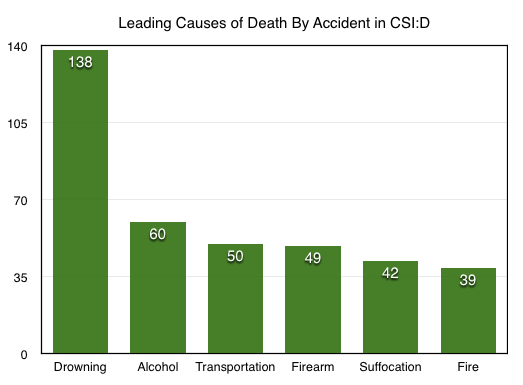
Alcohol was such a critical indirect cause in so many of the accidental drownings, shootings, fires, and falls in CSI:D that it really ought to be regarded the deadliest force in nineteenth century South Carolina. In addition to these indirect roles, alcohol was the direct cause of accidental death in more than sixty cases. It was probably also a direct cause in many of the ‘exposure’ cases—bodies that were discovered outside and were thought to have died from exposure to the elements.
Nineteenth century law enforcement had no recourse to blood-alcohol tests. Even today, determining precise BACs postmortem, and working back from those to levels of inebriation at time of death, is fraught with difficulty. This meant that nineteenth-century coroners had to rely exclusively on witness testimony and the known habits of the deceased to determine alcohol’s role in producing death. Standing around a dead man, jurors found themselves passing judgment on just how drunk he had been the night before. According to witnesses, John Goodlett “seemed to be drunk.” John Agner was “sorry he was drunk.” Abe Waganan was “very funny & lively”—very drunk as [was] his custom.” Is ‘very drunk’ drop-dead drunk? It is hard to know. On the night of January 15, 1816, Angus McQueen drank more than half a gallon of spirits. “The dec’d was very much intoxicated,” noted one witness, “and fell down four times during which time he vomited upon the carpet.” Because McQueen kept getting up and falling down, the jurors determined that the falls (and the winter cold) contributed to his demise, though it is equally possible that McQueen died of alcohol poisoning. Juries were more likely to fix upon ‘intemperance’ as a clear cause of death if the deceased was a notorious addict. In December 1842, H. P. Church was discovered by his land-lady sprawled half on and half off of his bed. A “habitual drunkard” who had been continuously drinking for two weeks, she did not even bother to try and shake him awake. The inquest did not hesitate in finding that Church had died of intoxication.
The third leading cause of accidental deaths were ‘vehicular’ accidents, a catch-all category that includes drunken falls from a train and sober buckings from a horse. Further complicating this picture is the fact that many of the drownings probably belong in this category. There is little difference between falling unwitnessed off of a train and off of a boat, except that in one case you land on tracks and are quickly found where in the other you wash downstream, far from the site of the accident.
Bartholomew Darby was thrown from the saddle and hit his head on a stump, his wagon then “running over his head ... & breaking his neck & deeply cutting him under the right ear.” Steve Yeldell fell out of his cart and broke his neck.
All such accidents pale in comparison to the staggering mortality brought to South Carolina by train. Richard Springs was “run over by a train.” Fannie Ford was “run over by a train.”A slave named Sam was “Run over by [a] train.” Almost as soon as trains arrived in these counties, there were sots to fall off of them, laborers to be crushed by them, and depressives to jump in front of them. Indeed, it is hard to imagine a technological innovation responsible for a sharper uptick in the per capita death rate. It is also clear that coroners and inquest juries were unprepared for the level of bodily violence meted out by train. The body of a slave named Berry was “very much mashed and limbs and bones severed.” William Abbott’s body was “mangled, bruised, cut and crushed.” Even so coroners and their juries were often at pains to absolve the railroad itself of any wrong-doing. Hosea Jackson “came to his death by his own carelessness and from no carelessness whatever on the part of the engineer.” The crushing of William Roberts was likewise “not caused by any dereliction of duty on the part of the rail-road employees.” With train accidents we see for the first time the question of corporate responsibility, and potential corporate liability, creeping into the inquest process.
The larger point, however, is a physical one. Moving the body at a faster speed than the body was designed to go is an enormous convenience that has to be paid for. Today vehicular accidents (car, motorcycle, and all-terrain-vehicle) are the fourth-leading cause of death among Americans after heart disease, cancer, and stroke. The nineteenth century was not particularly different, except that families moved by horse, wagon, and train—and died less often of cancer.
The fourth leading cause of accidental death in the CSI:D sample involved the discharge of firearms. Some were simple cases of men who were cleaning or handling weapons that suddenly went off. The vast majority of cases, however, involve an unfortunate bystander. In 1849, Tilman Attaway was mistaken for a turkey by his hunting buddy. In 1808, James Spradley was leaning in to watch two dogs fight over a dead deer. Fourteen-year old George Nettles sought to break up the dogs by bashing one of them with the butt of his gun. Instead the gun discharged into Spradley’s face. As this case attests, guns and children made as disastrous a pairing then as they do now. In 1820 ten-year old Mancel King accidentally shot and killed his brother. In 1899 ten-year old John McManus shot and killed his friend. “I was fooling with the pistol and it went off,” he told the inquest.
Undoubtedly some of these gun-related ‘accidents’ were not accidents at all. A dead man alone in a room might have been cleaning his gun, or he might have harbored hidden miseries. Similarly some of the accidental misfires on bystanders were probably intentional homicides. Unless new evidence emerges at this late date, however, such cases will have to remain categorized as accidents.
The fifth leading cause of death by accident in the CSI:D sample was death by suffocation—another category that speaks more to what a coroner was called to investigate than to what people actually died from. A majority of the ‘smothering’ deaths were probably SIDS victims. In white households such cases would not have been investigated—infant mortality was relatively high in the period and a white family’s ‘dear pledges’ were often ‘recalled to God.’ But in a society where every enslaved child was as potentially valuable as a Lexus, infant death in the quarter was more rigorously investigated. Coupled with deep prejudices against enslaved mothers, inquests typically found that an unnamed “negro Child” was “negligently Smothered” by its mother, or that the enslaved child Lora was “accidentally smothered” in the family bed, or that the enslaved children Henry and Alcy were crushed in the night, having being “overlaid” by their parents. It is possible that such ‘negligence’ did occur among overworked and overtired slaves, and such findings were far preferable to those cases where enslaved parents were charged with infanticide.
The sixth leading cause of death by accident in the CSI:D sample was death by fire. Most homes in the period were made of wood. Most had fireplaces. None had a fire extinguisher. Fire was light and life, but it was also occasionally death. In 1866 a freedman named Sloan was burnt to death in a gin house. In 1890 a child named Julia Hightower wandered too close to the family fireplace. Her younger sister tried to dowse her with water to no avail.
These six types of accidental death—drowning, alcohol abuse, transportation mishaps, gun miscues, suffocations, and fires—account for 75% of the accidental deaths in the CSI:D sample. Other relatively common accidents involved falling trees and limbs, industrial accidents, and poisonings and overdoses. Rounding out the sample were accidents that were more unique. Home alone, Medora Williams had an epileptic seizure and fell into her own fireplace. Traveling with the Bailey & Company circus, George West was gored by his own elephant. (Some might not consider this an ‘accident’ since the elephant had ‘cause’; and acted with ‘intent.’)
NEXT: Natural Causes
Accident Inquests
| Name | Deceased Description | Date | Inquest Location |
Death Method |
Inquest Finding |
|---|---|---|---|---|---|
| Murray P. Humphrey | March 3, 1937 | at Chesterfield, Chesterfield County, SC | automobile |
upon their oaths do say Murray P. Humphrey received in Chesterfield County a mortal wound by car and wagon collision in the hands of some bring unavoidable accident |
|
| Charlie Myers | April 19, 1939 | at Pageland, Chesterfield County, SC | automobile |
upon their oaths do say that Charlie Myers received in Chesterfield County a mortal wound by Stuck by automobile in the hands of Thomas Gregory |
|
| Joshua Johns | May 17, 1937 | at Chesterfield, Chesterfield County, SC | automobile |
upon their oaths do say that Joshua Johns received in Chesterfield County a mortal wound by Fred W. Hinson with automobile in the hands of anautomobile accident |
|
| Fannie Dennis | March 6, 1950 | at Cheraw, S.C., Chesterfield County, SC | automobile |
upon their oaths do say that Farris Dennis received in Chesterfield County a mortal wound by Car-Truck Collision in the hands of Tim Robinson |
|
| Hampton Stokes | October 13, 1941 | at McBee, Chesterfield County, SC | automobile |
upon their oaths do say that Hampton Stokes received in Chesterfield County a mortal wound by being hit by automobile accidently in the hands of Mrs. Grace M. Stetzel |
|
| Daniel Sams Jr. | April 8, 1924 | at Black Creek, Chesterfield County, SC | automobile |
the Verdict of the Jury and Medical examination that the said Danial Sams came to his Death by Misfortune and Accident, by Ford Car, The Said Daniel Sams jr Resides in Hoffman N.C. |
|
| Betty Lou Burch | May 29, 1944 | at Chesterfield, Chesterfield County, SC | automobile |
upon their oaths do say that Betty Lou Burch received in Chesterfield County a mortal wound by car in the hands of Thomas Jack Welsh |
|
| Emma Ellerbe | April 6, 1925 | at McBee, Chesterfield County, SC | automobile |
the verdict was brought out. . .That one Emma Ellerbe in manner and form aforsaid came to her death by misfortune and Accident. By being struck by auto accidently. |
|
| Hardy Lindsay | February 16, 1937 | at Chesterfield, Chesterfield County, SC | automobile |
upon their oaths do say that Hardy Lindsay received in Chesterfield County a mortal wound by Motor Vehicle in the hands of parties unknown |
|
| Fred Demby | October 12, 1945 | at Pageland, Chesterfield County, SC | automobile |
upon their oaths do say: Fred Demby came to his death by a car being driven by the hands of Abe Clark |
|
| Heck Curry | January 22, 1940 | at Chesterfield, Chesterfield County, SC | automobile |
upon their oaths do say that Heck Curry, Tom Oliver, Lennie Pope received in Chesterfield County a mortal wound by automobile collision in the hands of Heck Curry |
|
| Mma Mildred McDonald | September 30, 1935 | at Cheraw, Chesterfield County, SC | automobile |
upon their oaths do say that Mia Mildred McDonald received in Chesterfield County a mortal wound by being struck by an automobile in the hands of Frank Stokes, Jr. |
|
| Grafton Mims | December 14, 1936 | [no location given], Chesterfield County, SC | automobile |
[No official declaration] |
|
| John G. Tyler | January 28, 1868 | at M.r Allens Store, Horry County, SC | alcohol |
upon their oaths do Say the Deceased came to Death from the effects of ardent Sperits administered of himself by his own act |
|
| R. T. Bailey | June 13, 1858 | at Greenville CH, Greenville County, SC |
upon their oaths do say that the said R. T. Bailey came to his death by falling into Reedy River newar Greenville CH this day and was accidentally drowned. |
||
| Jim Coleman | freidman | November 15, 1866 | at the Mackey Place on horse Creek, Edgefield County, SC |
upon there Oaths do say that the said Jim Coleman came to his death by accidently falling in to horse Creek and drowning |
|
| Mike | negro man | September 13, 1844 | at Dr John D. Nicholsons Mill, Edgefield County, SC |
upon there oaths do say that the said deceased came to his death at the said Mill the tenth instant when the said Mill broke and washed away, and at the falling in of the mill the deceased received a wound over his right eye which stuned him and caused him to drown |
|
| Benjamin Grady | August 28, 1886 | at Brocks Mill, Chesterfield County, SC |
upon their oaths, do say: That the Said Benjamin Grady came to his death by being accidently Drowned in Brocks Mill Pond on 27th day of August 1886 |
||
| George Lindsay | May 7, 1945 | at Chesterfield, South Carolina, Chesterfield County, SC |
[No official declaration] |
||
| Ben F. Williams | March 13, 1895 | at M. C. Williams, Chesterfield County, SC |
upon their oaths do say Ben F. Williams came to his death by accident or misfortune |
||
| Willie Chappell | June 18, 1882 | at Badgetts quarter, Laurens County, SC |
upon their oaths do say that the said Willie Chappell came to his death at Badgetts quarter place in Laurens County on Sunday the 20th day of June AD 1882 That Lucinda Bradford the said Willie Chappell by misfortune and contrary to her will in manner and form aforesaid did kill... |
||
| John McLeod | August 23, 1822 | at house of Widow McLeod in the fork of Lynches Creek, Kershaw County, SC |
have unanimously agreed that the said John McLeod has received his Death by unavoidable accident as he was pouring liquor into a barrel or cask . . . which liquor caught on fire and busted the said cask and as we suppose one of the staves struck the said deceased by which which we think he rec'd his death together with the volume of flame which issued from s'd spirits as on examination we found his face mortally cut and his body much burnt |
||
| Robert Johnston | May 23, 1891 | at Clarks Ferry below bridge on C. & G.[?] R R, Edgefield County, SC |
upon their oaths do say by Mischance and accidentally falling into Saluda river |
||
| Infant of Lucy Fowler | Infant of Lucy Fowler | April 23, 1870 | at the Barrieing [sic] ground near the Residence of John Ball, Laurens County, SC |
upon their oaths do Say the said child came to its death by accidental suffication [sic]. |
|
| Emma Beser | November 24, 1877 | at Broom's Mill, Fairfield County, SC |
upon their oaths do say that the said Emma Beser[?] came to her death by accidental drowning |
||
| Harry | negro boy | September 9, 1858 | at the residence of the Rev. J. L. Brooks, Edgefield County, SC |
say upon their oaths, that. . .the said boy name Harry. . .while in the business of driving the mules to work the machinery of the Cotton gin by some careless action of his own he was caught by wheel or wheels of the machinery and crushed to death |
|
| Nancy Crawford | August 9, 1876 | at Cooly's Grave Yard, Spartanburg County, SC |
upon their oaths do say that she came to her death. . .near the door of her house (being in labor) by misfortune or accident |
||
| Daniel Bragg | February 6, 1815 | at the plantation of Daniel Brag, Laurens County, SC |
do say upon their oaths saith that on the 5th of this instant in striving to save a negroe man he got drowned. |
||
| John T. Parker | November 23, 1945 | at Chesterfield, S.C., Chesterfield County, SC |
upon their oaths do say that John T. Parker received in Chesterfield County a mortal wound by Burns suffered in House fire, Origins Unknown |
||
| Luis Ratcliff | May 1, 1874 | at C. A. Mores, Chesterfield County, SC |
upon their oaths, do say: That the Said George Ratcliff Maggie Ratcliff & Luis Ratcliff came to there deaths by being accidently Burnt |
||
| Peter Knox | July 23, 1878 | near Calrandellers[?] Ferry on Tugalo River, Anderson County, SC |
do say that Peter Knox . . . in Tugaloo River came to his death accidentally by drowning in attempting to cross said river |
||
| Henrietta Brown | January 9, 1878 | at Thomas Blair's plantation, Fairfield County, SC |
upon their oaths do say the deceased came to her death by her clothes taking fie, and was burned to death. |
||
| George Wilkins | January 7, 1886 | Spartanburg County, SC |
upon their oaths do say taht George Wilkins came to his death by misfortune or accident from a gun shot in the hands of Jack Lewis |
||
| Isabella McClain | September 15, 1873 | at Conwayboro, Horry County, SC |
upon their Oaths do Say that She Came to her death by a Gun Shot Inflicted by one Cesar Beaty, though we Consider the whole transaction accidental |
||
| Rebecca Sherman | child | January 4, 1879 | at Greenville, Greenville County, SC |
upon their oaths do say that . . .the deceased Rebeccas Sherman came to her death . . .from the effects of an accedental burn |
|
| Margaret McKeown | May 5, 1860 | at Boykin's Mill, Kershaw County, SC | |||
| Alick Croker | boy | September 29, 1878 | at Mrs. Marshes premises, Edgefield County, SC |
Upon there oaths do say that the said Alick Croker came to his death by drownding |
|
| Thomas Rosseter[?] | August 30, 1852 | at Hamburg SC, Edgefield County, SC |
Upon their Oaths do say, that he, said Thos Rosseter came to his death by drowning . . .in the street in the town of Hamburg, during the high water Backed[?] out from the Savannah River |
||
| Tom Purvis | February 5, 1912 | at T. A. Hendricks Res, Chesterfield County, SC |
upon their oaths, do say: Tom Purvis came to his death By Accidental Gun Shot wound in the Hands of Ray Hendrick |
||
| George | February 6, 1815 | at the plantation of Daniel Brag, Laurens County, SC |
doth say upon their oaths saith that on the 5th of this instant in crossing Enoree River got wash. Off his horse and got drowned. |
||
| John Dawkins | July 14, 1904 | [in] Chesterfield County, South Carolina, Chesterfield County, SC |
before their oaths do say that the said John Dawkins caused to his death by his own negligence |
||
| Peggyann Goings | at S.R. Rutland's, Fairfield County, SC |
upon their Oaths do say that aforsaid children came to their deaths by accidental burning of the house in which they were fastined up on the morning of the 16th of March 1893. We also add our condemnation to the general practice of Colored Parents locking up helpless children in houses where there is fire. |
|||
| Alfred Gage | May 21, 1890 | at Milton, Laurens County, SC |
by their oaths do say that the said Alfred Gage came to his death "By Accidental Drowning in little river at the Mills at Milton. |
||
| slave | slave | January 25, 1836 | at the plantation of Daniel L. Desaushore[?], Kershaw County, SC |
do say upon their oaths that he came to his death by being intoxicated, falling in a rut or gully and thereby the storm[?] rain & sleet has drowned or frose [sic] to Death |
|
| William Davis | January 16, 1841 | at or near the residence of Alex. McMakin, Spartanburg County, SC |
[do say that] not having God before his eyes but being moved and seduced by the instigation of the Devil came to his untimely end. . .by drinking intoxicating spirits to an excess and attemting [sic] to vomet [sic] and strangled so that he finally lost his Breath and departed this life |
||
| infant child | infant child | January 18, 1892 | at the Plantation of L. G. Swearinger, Edgefield County, SC |
upon their oaths do say from suffocation |
|
| Aaron Hardin | June 24, 1845 | at plantation of Mr. Moses Chambles, Anderson County, SC |
do say that they believe the said Aaron Hardin came to his death by mischance and accident by the hand of God, the body being in such a state of putrifaction and mutilation as to prevent a discovery of any marks of violence or other causes of death. |
||
| Joe | infant negro | August 26, 1860 | at John Huiets, Edgefield County, SC |
upon there oaths do say that the child was over laid by his Farther dick |
|
| infant | April 15, 1879 | at the house of Mrs. Mary Smith, Spartanburg County, SC |
upon their oaths do say that the infant aforesaid came to its death ... from the ignorant neglect of said child by Sarah D. Smith, the mother of said child without intent to murder the child upon her part |
||
| George Fisher | March 14, 1826 | on the bank of the Broad River, Fairfield County, SC |
[upon their oaths] do say that the said George Fisher going into a certain River] called Broad River to fish traps for fish of his own will at a late hour of the night it happened that accidentally, casually, and misfortunate [he] was in the water of the said river then suffocated and drowned...and there instantly died |